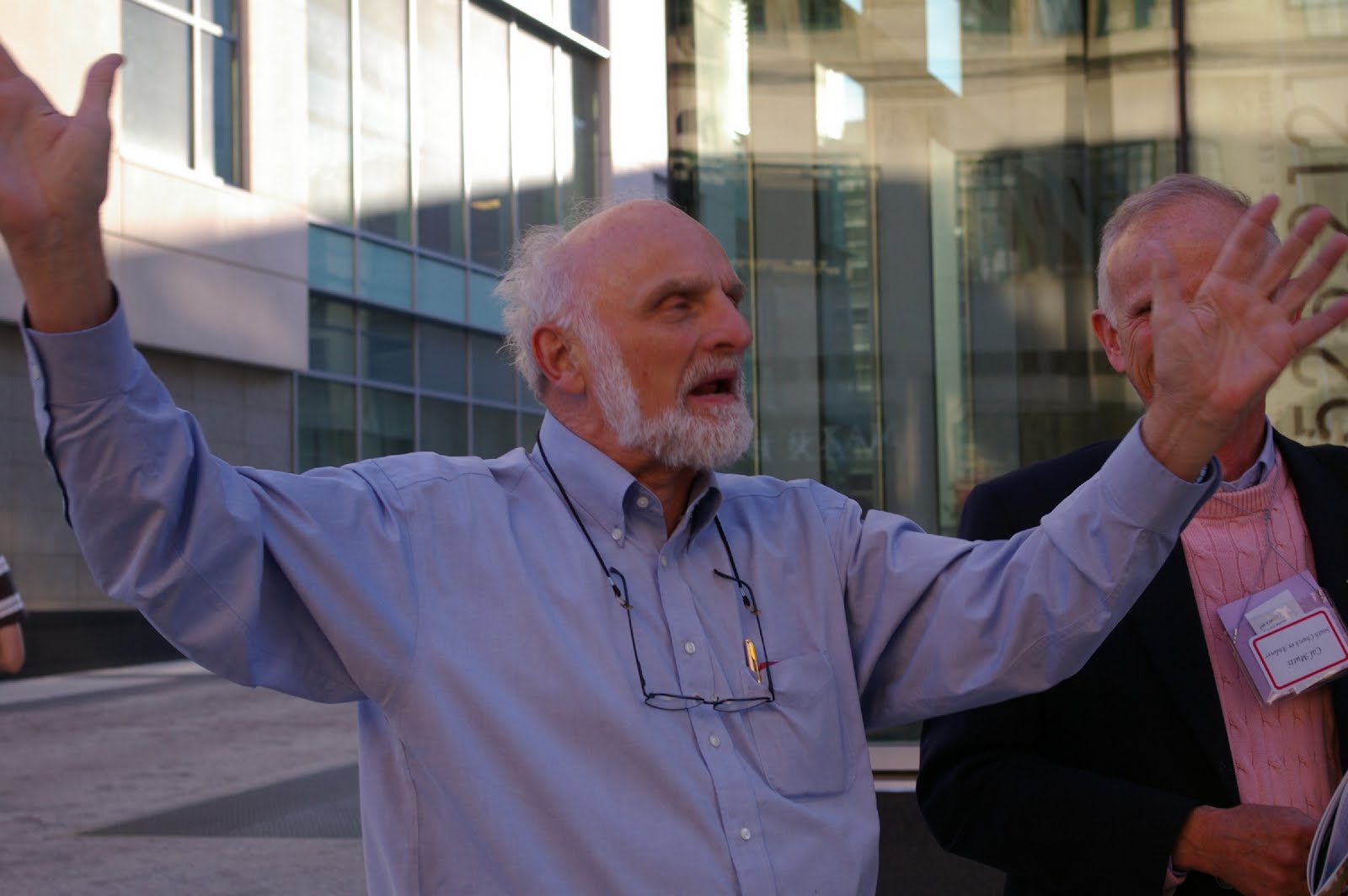
Saturday, September 17, 2011

Atheism out of the shadows


“The new atheism has been more than matched by the new sectarianism,” author and civil libertarian Wendy Kaminer told the nation’s religion journalists today.

Kaminer was part of a provocative panel called “Atheism Revisited” at the annual conference of the Religion Newswriters Association, help this year in Durham, N.C.

Todd Stiefel, head of the Stiefel Freethought Foundation based in Raleigh, N.C., has as his goal to more than match the sectarian forces in America.

While acknowledging the deep prejudice in the U.S. that faces anyone who proclaims they do not believe in God or doubt the existence of a divine being, Stiefel is part of a new civil rights movement hoping to build on the increase in Americans who stand outside any of the traditional religious currents.

“We need the same passion as other movements for equality,” he said.

For New Testament scholar and best selling author Bart Ehrman, who teaches at the University of North Carolina Chapel Hill, the story is more personal than societal. Still, he told how his public movement from evangelical Christianity to agnosticism has narrowed his job options, gotten him disinvited from speaking engagements and hurt the sales of textbooks he has written.

The fact that a panel on atheism was at center stage for a group whose stock in trade is writing about religion for mainstream media was notable in itself. There is a recognition that there are good stories to be told among those who reject belief as well as those who embrace it and recognition that one of the trends in American society is an increase in those trying to increase the acceptance of those who reject religion.

Kaminer, who writes for The Atlantic Monthly among many other publications, said she traces the growth in the free-thought movement to what she called “the faith-based attacks on Sept. 11.” She said that people saw “the potential viciousness in religion” and rejected religion (although she acknowledged that for religious people, the reaction was to blame people for adhering to the “wrong” religion.

She talked about the therapeutic approach that seems to have dominated a lot of the discussions of atheism in recent years. Atheist talk about “coming out,” about forming “support groups,” and self discovery and self expression. “It’s been a highly successful movement from a therapeutic standpoint,” she said. “From a political and legal perspective, it’s been less successful and the therapeutic approach may even be counterproductive.”

She said that the free-thought movement has increased the visibility of atheists, but not their clout. “It is inconceivable for anyone to run for high office as an atheist,” she noted.

But Stiefel would like to change that, saying his mission is “seeking full equality for all free-thinkers.”

He told stories of groups rejecting charitable donations from atheist groups, of proselytizing by some military chaplains, of hiring discrimination against non-believers. He told of families torn apart when a son or daughter “comes out” as an atheist or agnostic.  And he told how the fastest growth among agnostics and atheists is among those 18-25.

Stiefel also talked of plans to boost the public visibility of the movement – community service projects, celebrity endorsements and a Reason Rally next March 24 on the National Mall in Washington D.C.

Ehrman talked about his own journey from a “hard-core, borderline-fundamentalist Christian” to one whose doubts about God increased as he explored the issue of suffering and where God fit in the midst of life’s tragedies.

Friday, September 16, 2011

Making a moral pitch on the economy


It does not take a lot of insight for a political scientist to say that the economy will be the most salient issue in the 2012 presidential election. But exactly how that plays out – and how religious factors affect the equation – provided good material for John Green and Laura Olson.

One important variable may be how the candidates cast the debate over the economy in moral terms.

Green is one of the nation’s pre-eminent students of the connections between religion and politics. A professor at the University of Akron, he is also a senior fellow at the Pew Forum on Religion and Public Life. Olson is a professor at Clemson University in South Carolina. They spoke at the annual conference of the Religion Newswriters Association on Friday in Durham, N.C.

Olson argued that the real task for both President Obama and whoever his Republican challenger is will be to mobilize the religious middle in this country – a group that constitutes about a third of the electorate.

Will the budget debate be framed around the morality of not leaving the next generation to pay the bills of this generation? Or will it be framed around protecting the least of those in society?

There are moral values underlying both of those appeals, but they have their touchstones in different religious groups.

Catholics, for instance, while identified most often with issues around abortion, may well resonate with talk about social justice, a concept deeply imbedded in the teachings they grew up with, a concept that is often framed as part of a consistent ethic of life.

Many Protestant denominations, too, have emphasized Jesus’ message of caring for others as central to their faith. And yet there are also strains of not passing on one’s burdens to others, of not forcing charity but seeing it as a voluntary good that underscores some of the conservative approaches to the economy.

Olson was one the one who articulated the moral dimensions of the budget debate most thoroughly in this discussion. Olson cautioned that part of the needle that candidates have to thread on these issues is that Americans are quite ambivalent on expressions of faith by public leaders. They want leaders to be “moral” but not too “sectarian.”

So a lot of the language around issues like the economy will be framed broadly, but with an appeal to moral values that candidates hope will make sense to the voters they are targeting.

Thursday, September 15, 2011

Muslims in America: From fear to the future


The early stories are about fear.

Americans fear about Islam after the attacks of Sept. 11, 2001.

Muslims fear about what life holds for them in this nation.

The current stories are about crossing bridges, tentatively at times, but with some sense that there may be something better on the other side. Students of different faiths share service projects.  Adults begin to share their beliefs.

The stories of the future grow out of the histories of other beleaguered religious groups in this country – Catholics, Jews, Mormans.

The stories were told in many ways by many voices during a day-long seminar today at Duke University in Durham, North Carolina. They were told by professors, by religious leaders, by students, by journalists.

The gathering was for members of the Religion Newswriters Association as it began its 67th annual conference. The session was hosted by Duke’s Islamic Studies Center.

First, the fear.

Eboo Patel, the founder and leader of the Interfaith Youth Corps, a dynamic voice for crossing those bridges that separate faith traditions, recalled the signs he saw at protests: “All I know about Islam I learned on Sept. 11.” They were signs reflecting the fear of Americans who knew little about Islam and who let the attackers who not only hijacked airplanes but who also hijacked Islam define this long, rich and varied religious tradition.

The fear is reflected more recently in signs opposing the use of Shariah law in America, the efforts in 16 states to ban the use of Shariah law – efforts based in a fear stoked up by those who would demonize Muslims with no basis in reality.

The fear was reflected in the experience of Nona Sherif as she arrived for classes two years ago at Duke and met a woman on her way to the bookstore who grabbed the cross around her neck and held it out towards Sherif with a look of terror on her face.

The fear was reflected in the phone call Patel received from his mother after efforts to build a Muslim community center in New York City burst in to a spasm of anti-Muslim feeling across the nation. She told Patel his kids’ names – Zane and Kalil – sounded to Islamic and he ought to Americanize them before it was too late.

Charles Kurzman, a professor of sociology at the University of North Carolina at Chapel Hill, offered some facts as an antidote for Americans’ fears.

He recently published a book called The Missing Martyrs: Why Are There So Few Muslim Terrorists. He talked about the data he had gathered. Since Sept. 11, 2001, there have been 175 arrests in this country for Muslims suspected or convicted of acts of terror. That’s not quite 18 a year … and some of those were arrested as they were headed to foreign lands like Somalia to join terrorist groups there.

Kurzman’s point is not that there are not threats from terrorists, but they are not anywhere near as overwhelming as the fear industry would have us believe. And, important in the context of this day’s discussion, they represent an infinitesimal fraction of the Muslims in this country.

Imam Abdullah Antepli, the Muslim chaplain at Duke, does not deny that there is what he called “the cancer of Islamic terrorism” in this world. But he called for a better understanding of the roots of that terrorism not in the theology of Islam but in the political and economic actions of major world powers.

“Radicals, extremists, are not products of Islamic theology or Islamic societies,” he said. “They are products of deeply broken societies, products of American foreign policy, products of greedy economic policies.”

When someone challenged him on citing American foreign policy as a factor, he asked that as an American Muslim, he be given the same opportunity to call for a better foreign policy that other Americans have.

He also told one of the most compelling stories of the day. Last month, he was in Afghanistan, where for the first time in his life, he came face to face with Muslims who believed it is their duty to kill Christians and Jews.

“I went ballistic,” he told me later. He said he pulled a Koran out of his pocket and argued verse by verse with them. He was so shaken by the experience, he now plans to go back to Afghanistan every summer to build programs to counter that kind of ideology.

“There is a form of Islamic theology that prepares the ground for violence,” he acknowledged. “That theology is reinforced through certain foreign policies and economic policies. People who are not religious at all suddenly find resonance in that theology. It will take global efforts to eradicate this poison,” he said in explaining his hopes for this project in Afghanistan.

But in the midst of the fear, there are efforts in this country to find the bridges that will ease the fear.

Meredith Rahman, a sophomore at Duke studying French and biology, noted that the head of the Muslim Student Association on campus is not a Muslim. This is a bridge.

The other students all talked about the pressure they feel as Muslims in a largely non-Muslim environment to explain their faith, to act in proper ways, and yet they also described that as an opportunity to help shape a more pluralistic society.

Patel calls this an example of how Muslims in America are moving from “the architecture of the bubble to the architecture of the bridge.”

He noted that Muslim immigrants who came to this country initially focused on building their own institutions, on staying relatively separate from the dominant culture, much like Catholics and Jews did as their communities took root in America. That was the bubble.

The reaction to Sept. 11 changed that. Muslims came to realize that they had to engage the wider community, they had to become part of the American experience. Just as Catholics and Jews and Mormans faced deep-rooted prejudice at one time and now are part of the American mainstream, he sees that happening to Muslims as well.

“We are going to be part of the story of American opportunity and expansion,” Patel said.

(Patel and other speakers also cautioned that there are two very different Muslim experiences in the U.S. – the immigrant Muslim community that is getting most of the public attention, and the large African-American Muslim community, that has lived a very different experience in this country. He acknowledged the absence of the African-American Muslim view on this day.)


A few days with the nation's religion writers

Greetings from Durham, N.C.

I'm here with journalists from around the country who write about religion for the nation's newspapers, magazines, web sites, etc. The group is called the Religion Newswriters Association and it's one of the fine professional associations for journalists.

Today, we'll explore "Muslims in America: The Next 10 Years" in a pre-conference program at Duke University. One of the speakers willl be Eboo Patel, whose book, Acts of Faith: The Story of an American the Muslim, the Struggle for the Soul of a Generation, is on deck for our next Friday morning book group at Memorial UCC.

Other things coming up - tonight, the author of a new book on teen sexuality; Friday, sessions on the new evangelical mega-churches that serve many sites simultaneously and are breaking new ground in the use of social media tools; a panel on religion in the 2012 elections; a briefing called "Youth in Crisis: What Everyone Should Know About Growing Up Gay;" how journalists can use social networking effectively.

Then on Saturday, breakfast with the family that inspired HBO's "Big Love" series; reports on studies of changes in American congregations; on the depth and complexity of America's religious landscape and a new study on the demographics of American Muslims. There will also be a provocative panel called "Atheism Revisited."

It promises to be a very rich few days. Stay tuned.

Friday, August 19, 2011

Voices for social justice in a divided state

On Aug. 18, 2011, I was part of a group of religious leaders who unveiled a statement drawing on our faith traditions to address the breach in the social covenant in Wisconsin during the past eight months. Here are my comments at the news conference. Afterwards, a group of us took the statement to Gov. Scott Walker's office as well as to the legislative leaders of both parties in the Assembly and the Senate.

As a pastor at a local congregation, I get several calls a week from folks who need financial help to keep from being evicted or need help paying overdue utility bills or people feeling domestic violence who need a security deposit for a new place to live. As pastors, we experience the issues facing people on the margins of society in a very personal way.

We're gathered here at Grace Episcopal Church, which hosts one of the primary shelters for homeless men in the Madison area. The congregation I serve helps with meals at the Community Meal Program and gathers items for food pantries. All of us here look for ways to shelter the homeless, feed the hungry, care for the sick. And these are important actions.

But we also know that there are conditions in our society that make things harder for people on the margins. So we also look at issues of justice. In the United Church of Christ, when someone is baptized, they promise to follow in the way of Jesus, "to resist oppression and evil, to show love and justice." Seeking justice is a core part of what it means to be a follower of Jesus.

That's why we make our voices heard on behalf of the poor, the marginalized, the oppress in public debates. Our statement on the social covenant looks back at how that has frayed in the first half of this year. But we are also looking forward, signaling that our voices will continue to be raised on behalf of those being left out. Our statement focuses on the state level, but we know this has an impact on the county and city as well. Scott McDonell from the Dane County Board is here. He and his colleagues need to keep the needs of the most vulnerable in mind as they approach this year's budget.

We know that in a democracy, elections are the heart of the democratic process. We know in Wisconsin over the last year through a series of elections that the people of this state are closely divided on the direction this take is taking. We also know that a democracy is more than voting. The First Amendment to the U.S. Constitution spells out the many forms of democracy - freedom of religion, which means our voices have a place in the public square, recognizing that other faiths, even other understandings of Christianity, also have a place in this debate. The First Amendment also talks about freedom of the press, freedom of speech, freedom of assembly. We've seen a lot of that around this Square in the last eight months. And it talks about the right to petition our government.

Now we are going to walk over to the Capitol and petition our government as we deliver copies of our statement on the social covenant to the governor and the leaders of the Legislature. We hope you will join us in being voices for those who are most harshly affected by the actions of the last several months.

Thursday, July 7, 2011

UCC folks "imagine what's possible"


There was sand everywhere at the national gathering of the United Church of Christ this past week.

There was a small sandy beach at the foot of the stage that was the platform for worship. There was sand in the bright red cabanas at the far ends of the assembly hall. There was the expanse of a sandy desert projected on the screen across the back of the stage. And, of course, there was sand on the real beaches of the Gulf shore along the coastline near Tampa.

This gathering is called a General Synod - the 28th such gathering since the UCC was formed in 1957. It is the decision-making body for our denomination, but it is also a place to connect with the many and varied segments of the UCC, to delve into vital social issues and to get new energy in those times when we feel we are just wandering on the hot sand.

"Imagine What's Possible" was the theme of this gathering. As the event moved toward it's conclusion, the images of sand gave way to images of water - an ocean on the screen as well as fresh branches dipped in water that was sprinkled over the crowd at the closing worship as we sang about "crashing waters at creation" and "living water, never ending" that can "drench our dryness, make us whole."

This was a place where younger clergy could stage an unannounced "flash mob" communion service in the lobby of the convention center.

This was a place where Pulitzer-Prize-winning columnist Leonard Pitts could challenge the crowd to live in such a way that when the news media find them, “they find you living in authentic faith, a faith in service to humankind. Make sure they find you up to your knees in the muck of the nation’s troubles, working and praying for changes that other people deem impossible.”

This was a place where delegates could live out those words when the left the hall to join tomato farm workers in a protest outside a nearby Publix grocery store seeking a one-cent increase in what they pay for a pound of tomatoes so that the workers could receive their first increase in wages in 30 years.

This was a place where one of our new leaders, J. Bennett Guess who was elected to head Local Church Ministries, said that the measure of our success is neither membership nor money given, but rather mission. “McDonald’s doesn’t tell you how many stories they have,” Guess said, “they don’t tell you how many employees they have. They say what matters in a service industry: billions and billions served. The church needs to learn to do the same.”

One way the UCC is going to do that is with a major initiative this fall called Mission 1 – using the first 11 days of November to focus on feeding the hungry and confronting food-related injustice. We’ll be exploring that more at Memorial UCC in the months ahead.

During the Synod, we adopted a number of resolutions highlighting some of the difficult issues in our world.

The battle for rare minerals in Congo that are used in our cell phones and computers has brought horrible oppression on the people of that nation. The UCC said it would advocate on behalf of the people of Congo.

The threats to gay and lesbian people in many nations put their lives at risk and the UCC promised to fight against that.

The suspicion of Muslims in this country festers and the UCC promised to work against such hostility.

There were resolutions on mindful eating, adoptions for gay and lesbian couples, the nuclear test ban treaty, political prisoners in Puerto Rico.


We also took a step toward smoother relationships among Christian denominations by adopting a common statement on baptism shared by Roman Catholics, Presbyterians, the Reformed Church in America and the Christian Reformed Church. This should remove an obstacle that sometimes gets in the way when people change denominations.

And within the UCC, we streamlined our governing structure so there is a smaller but still widely representative governing board and fewer barriers between the various agencies that work within the UCC.

The leaders of the UCC sketched out the three "core values" they see within our denomination - continuing testament, extravagant welcome for all, and changing lives.

We had powerful worship services throughout the week, but it was the ending of the final worship service that really offered an image of hope for our future. As Rev. Geoffrey Black, the general minister and president of the UCC, took the stage, he invited the teens and young adults to join him on and around the stage. They came by the hundreds. Then the teens offered a blessing to Black and the four other top leaders of the UCC (three of them newly elected) and the officers, in turn, offered a blessing to the young people.

Then music and dancing broke out, the young people took the branches and sprinkled the crowd with water as a reminder of baptism and finally, standing alone once again on the stage, Geoffrey Black sent us all out to do God’s work in our world, to carry the light to all the earth.

Thursday, May 19, 2011

Woodstock for Preachers - final notes

After a week of hearing some amazing preachers and musicians, participating in a wide variety of worship, sharing stories with colleagues and gathering materials to bring back home, a few final notes:

Barbara Lundblad, preaching professor at Union Theological Seminary in New York City, offered a rich menu of options for thinking about Ordinary Time – that time between Pentecost and Advent. It does not really need to be so ordinary, she said, offering great opportunities to explore the stories and themes that really define the realities of every day life for Christians in some ways even more than the big feasts do.

Brian McClaren took us on a journey of spiritual development, from simplistic to complex, from perplexed to harmonious. And then he led us to scripture texts and spiritual practices that allow us to sink into each of those stages.

Diana Butler Bass offered a provocative look at “Christianity After Religion” (which happens to be the title of her next book that will be out next February). The key idea from her two-hour presentation – belief, behavior and belonging are the ways people enact religion and those are all in flux. We are creating the new future.

And since the end of the world is coming on Saturday, musician Nate Houge suggested we had all made a wise decision to spend our continuing ed money early in the year this year.

Actually, I think it was a good idea even if the sun rises again on Sunday.

Falling, dying and then what?


Death was in the air as Barbara Brown Taylor talked at the opening session of the Festival of Homiletics last Monday.

The death of a grain of wheat in the ground.

The death of a man on a cross.

The death we fear in our own lives.

The death of churches as we once knew them.

“It’s hard to preach the Gospel to people who are scared to death of dying,” Taylor said. She’s a noted author, teacher, preacher.

She talked of how people come to pastors looking for the Jesus who can give them a pass on “the full catastrophe.” Then they meet the Jesus who said “unless a grain of wheat falls into the earth and dies, it remains just a single grain; but if it dies, it bears much fruit.”

That’s not a message calculated to increase church membership, Brown noted.

And then pastors themselves start focusing on a message that will bring to people to their church. But then, Brown added, “it’s hard to preach self-preservation is the presence of the cross.”

This led to her key observation: “No one is much interested in learning to fall. We all want to rise.”

So then maybe we learn how to find salvation in the falling.

She talked of being at the bedside of someone dying. Death is very literal in this case. And yet as the family gathers around, stories are shared, good-byes are said, hands are held in prayer, touches are exchanged, there is life emerging from the death.

She talked of a family devastated by the falling economy. No more meals out, cable television gone, no trips to the movie theater. Instead, there are books read together, games played on the living room floor, meals around the kitchen table. Is it what they were used to, what they had hoped for? No. Was there high anxiety? Yes. And was new life emerging out of the falling? Yes.

“There are worse things than falling on the ground that can happen to a grain of wheat,” she suggested. The grain of wheat dies and gives birth. Jesus knew about bread. Jesus knew about life.

Death was in the air. And so was life.

Trust this, Brown suggested. When you are falling, “God will know what to do with you next.”

Or as Anthony Bailey said as he thanked Brown for her words, “We are all waiting to fall into the waiting arms of God.”

Wednesday, May 18, 2011

Speak boldly, listen deeply


For Walter Brueggemann, the message was one of speaking boldly the things preachers often feel they cannot say.

For Krista Tippett, the message was one of listening more carefully, more deeply, to those who may disagree with us.

Both are vital messages to people engaged in the very public role of preaching in the nations’ congregations. They came in very different voices at the Festival of Homiletics this week in Minneapolis.

Brueggemann looks like what I imagine a Hebrew prophet would look like – tall, white hair (what hair there is), grumbly voice, piercing eyes. But he also has a sense of humor not often associated with those prophets. And he has a resume as a scripture scholar and professor that includes more than 50 books.

And as befits someone who looks and sounds like a prophet, today he used the story of Jeremiah, that dour profit of Israel, as his model for what happens to preachers when they are unable to speak hard truths. It tears at their guts, he said.

Or perhaps George Carlin and his seven words that could not be said on broadcast television should be the model, he suggested.

“George Carlin is not the last one who has a list of the unsayable,” Brueggemann said. “There is, for instance … you.”

It’s hard for today’s preachers to say that the war is stupid, that capitalism has failed in its excessive greed, that oil spill is a measure of Western technological hubris, that we have forfeited our democracy to a secret government protecting the wealthy. They can’t say that parents racing to get their kids to soccer practice and dance lessons will never win the rat race or that we can’t welcome the immigrant.

“It takes so much energy to remember what not to say,” noted Brueggemann. “What we cannot say (echoing Carlin) is that the body is fragile and smelly and cannot be otherwise. What we cannot say is that our body politic has the smell of death about it.”

OK, that’s harsh. And Brueggemann was quick to note that as a tenured professor, he has a lot more latitude to be harsh than the average pastor in the pulpit – what he called “such a dangerous place as you are every week.”

Then again, Brueggemann suggested, “you will get your self back in telling the truth before the authorities.”

Tippett is a soft-spoken radio host whose public radio program, “On Being” (formerly “Speaking of Faith”), explored people’s beliefs in a thoughtful, respectful way. And she is fascinated by how that kind of listening can lead not to agreement but at least to a deeper respect across ideological and theological lines.

“Listening is part of truth telling,” she said, reflecting on what Brueggemann had said. But it sure has a different feel to it.

She quoted Dietrich Bonhoeffer, the German pastor and martyr during the rise and fall of Nazism who said, “Christians are talking when they should be listening.” She noted that in the American political landscape in recent years, Christians have not been famous listeners.” (And those doing the speaking don’t have quite the same views as Brueggemann.)

So in an era when the pace of change has forced fundamental questions about life and relationships and authority and faith to the forefront, Christians have centuries of resources to draw on – but that requires asking questions with deep meaning and listening with sincere interest to the variety of answers.

“There is something redemptive and life giving that comes from asking better questions,” Tippett said, with the experience of one who has asked questions for years. The task for preachers, she said, is to “help people live the questions until they can be answered in their fullness.”

She talked about her conversation with Frances Kissling, the woman who for many years led Catholics for Choice. Now in retirement, Kissling is working on creating new relationships with her political opposites.

Two key questions Kissling asks:
What can I see that is good in the position of the other?
What troubles me in my own position?

This is not to reach agreement, Tippett noted. It is to understand better what the other – and you – believe. And a task for the church is to create the safe spaces where those kinds of conversations can take place. It goes back to that old Christian practice of hospitality.

Speak boldly, said Brueggemann, even about things you think you are forbidden from saying. Listen deeply, said Tippett, even to those you disagree with sharply. For both, a care with words and an honesty of spirit, a vulnerability of self and a tending to the soul are critical.

Tuesday, May 17, 2011

Gospel shouts and the blues


Notes from the Festival of Homiletics this week in Minneapolis.

The blues notes from pianist Kwasi Kena were still echoing in the room when Rev. Otis Moss III strode to the pulpit. He’s the pastor of Trinity United Church of Christ in Chicago and one of the most dynamic young African-American voices of our era.

The scripture text he read was a bit obscure – a passage from the Jewish prophet Ezra about the rebuilding of the temple in Jerusalem. A new generation of Levites – special temple workers – were appointed to oversee the construction. When the foundation was done, priests in their vestments and the Levites with cymbals sang songs of praise and gave thanks to God. But, wrote Ezra, the older generation “who had seen the first house on its foundations, wept with a loud voice when they saw this house, though many shouted aloud for joy, so that the people could not distinguish the sound of the joyful shout from the sound of the people’s weeping, for the people shouted so loudly that the sound was heard far away.”

Or as Otis Moss said, “they could not distinguish between the Gospel shout and the blues moment.”

He talked about the role of the blues in Africa-American culture, whether in music or food or comedy, where ‘joy is always married to sorrow.” He talked about the “blue note” – waking from addiction lying in your own vomit, the son returning from two tours in Iraq only to be murdered on the streets of Chicago.

“If you want to learn to worship, you must learn how to weep,” Moss said. “If you want to get to the joy of Easter Sunday, you’d better deal with the pain of Good Friday.”

Moss knows how to play with words, to create rhymes and construct words to keep his audience engaged and laughing. But he kept coming back to the notion that God is a God who knows the blues. If we are true to our history as human beings, we too have to include the blues in our Gospel songs.

World, church, sanity, insanity


Notes from the Festival of Homiletics this week in Minneapolis.

At first, it sounded like they had very divergent views on the “world” versus the “sacred,” these two preaching superstars.

Tom Long, a Presbyterian who teaches at Candler Seminary in Atlanta, talked about the tensions between sanity and insanity, how those who think they are sane may in fact be part of the demonic insanity of the world.

Barbara Brown Taylor, an Episcopalian who teaches at Piedmont College in Georgia, warned against pitting the “world” against the “church.” As she told the 1,700 or so preachers at others gathered here for the Festival of Homiletics, “watch your language, especially when you are talking about the world.”

Long was reflected on the story in Mark’s Gospel of Jesus driving demons from an insane man into a vast heard of sheep that plunged to their death. He talked about the “apocalyptic combat between the holy and the demonic” that runs through Mark’s telling of the story of Jesus, adding that often “it’s hard to tell the difference between the holy and the demonic.”

The religious bureaucrats of Jesus’ day, after all, “checked their DSM4s and said, yes, he’s insane all right. Not even CPE could help him.” (Acronym decoder: Diagnostic Statistical Manual and Clinical Pastoral Education)

Long talked about the 19th century composer and pianist Franz Liszt, who was a rock star in his era, then confounded people when he threw himself into a lifestyle modeled on Jesus. As he was dying, writing a piece of music that Long described as moving from frenzy to shalom, Liszt’s son-in-law, Richard Wagner, said to Liszt’s daughter, “I think you father is insane.”

Who was more insane, asked Long? The musician wrestling with the deepest questions of life or the one whose martial music and anti-Semitic writings would become favorites of Adolph Hitler?

While Long was not exactly casting the world against the sacred, BBT worried that too many preachers do just that – including an earlier version of herself. She described the transformation she went through that led to her book, An Altar in the World,” where she went beyond the church-based use of tangible items – water, bread – to the patterns of church life that led her to see the sacred in filling a cat dish with water or eating a cucumber sandwich at her desk.

Instead of pitting the world against the church, the flesh against the spirit, she wondered what happened between the creation stories of Genesis and the line in the Epistle of James that says, “whoever wishes to become a friend of the world becomes an enemy of God.”

What happened, she said, was Caesar. The Roman emperor defined himself as God and Jesus created a world in opposition to Caesar’s world. This was not the same as calling flesh bad. Jesus, after all was the word made flesh, the incarnate God.

BBT talked of finding the sacred in the line at the post office as a little girl kissed her wounded hand, in the chemotherapy room where she sat with her father, in the walks and touches and thirsts that fill her life.

Watch your language, she told the crowd. God is in the world.

Wednesday, February 16, 2011

Day three of labor protests

Labor Protest Feb. 16, 2011

Tuesday, February 15, 2011

Standing in the stream of justice

By Phil Haslanger
Feb. 15, 2011
In the midst of the thousands of people gathered on the Capitol Square on Tuesday was a small group holding up signs saying that people of faith support working people. They were invoking a deep stream in the major faith traditions that supports the efforts of working people to band together to defend their interests.

These streams draw on the biblical call for treating workers justly. They draw on the biblical notion of covenants that bind people to one another. They draw on the biblical teachings of people looking out for one another. These streams are deep within my own Christian tradition and they are what brought me to stand with other religious leaders in the midst of the crowd.

The gathering at the Square – inside and outside the State Capitol building – was to protest Wisconsin Gov. Scott Walker’s fast-tracked proposal to effectively eliminate most collective bargaining for most state and local public employees.

There are immediate economic consequences for some 175,000 state and local workers if the Legislature adopts this plan. In one measure, those are the give and take of tough economic times. The more serious and long-term consequence, though, is abolishing the right of public workers to negotiate with their employers. And that’s at the heart of what brought religious leaders to these days of intense demonstrations.

No, Jesus did not say anything about the right to unionize. And yes, followers of Jesus and people in other faith traditions may well have differing views on the proper balance to be struck between employer and worker. No economic structure is perfect.

Within faith traditions, though, there is a consistent message of defending the rights of workers against those who would exploit them. In contemporary America, there is a history of Christian and Jewish leaders joining union organizers to make sure that individuals are protected from the economic and social forces that can overpower workers.

Yes, it is a little trickier with public employees, because they do not work for a profit-making entity. It is taxpayers that ultimately pay their wages and benefits. Ordinary taxpayers have taken quite a hit of late as the tax system has tilted more and more to reward the wealthiest individuals and corporate entities in our country. So there is less sympathy toward public employee unions than might otherwise be the case since other hard-pressed workers worry about their tax bills.

Yet as my colleague Rev. Curt Anderson, pastor at First Congregational United Church of Christ, told the crowd on Tuesday, a consistent theme in the Bible is that “it is the responsibility of those in power to make sure that all workers are treated fairly.” That would include the governor and lawmakers who hold power in Wisconsin.

It is worth remembering that Rev. Martin Luther King, Jr., on the night before he was assassinated, spoke to public employees - sanitation workers - in Memphis, Tenn. who were seeking a contract with the city. He invoked the great story of the Jewish people breaking the bonds of slavery in Egypt by their unity in the face of injustice.

“The issue is injustice,” King told the crowd gathered in a church. “The issue is the refusal of Memphis to be fair and honest in its dealings with its public servants.”

But it is not just modern faith voices who speak about this. John Calvin, who lived in the 1500s in Switzerland, well before the formation of modern unions, described work as a calling from God to help build a better community but he also said that work should be wrapped in justice - safe working conditions, a living wage, and fair relations between employer and employee.

Those are some of things at risk in what Gov. Walker has proposed for public employees. My own denomination, the United Church of Christ, says that “Christians are called to accompany people wherever they are and especially through the rough places of their lives. So we must be in offices, factories, stores, farms, schools, health care facilities, and all the places where people work.”

So there I was with other religious leaders, standing with those on Square facing a particularly rough place in their work lives. I was there as a follower of Jesus who worked as a carpenter and who talked about treating others as we would like to be treated.

Or as the Jewish prophet Amos once said, “Let justice roll down like waters and righteousness like an ever-flowing stream.”

Friday, November 13, 2009

Listening for the voices

We shared lunch with Gosayna Karam in the ancient village of Nazareth, remembered as the town where Jesus grew up, and heard her talk about her worries for her children’s education in a country where there is huge disparity in funding between Jewish and Arab students.

We sat in the living room of Hani Abu Haikal, a Muslim living right next door to hostile Jewish settlers in Hebron, a city where both Muslims and Jews revere a site where they believe their common ancestor Abraham is buried. We heard how Hani is trying to create non-violent responses to the oppression of occupation.


We walked with Shadi through the Dheisheh Refugee Camp in Bethlehem, where 13,000 Palestinians live – the original refugees of the creation of Israel in 1948 and generations of their descendants, people without a country. We watched sewer water draining onto the narrow road we trod through the densely-populated camp.


We listened as Naila Kharroub, the principal of the Dar al-Kalima school in Bethlehem told about the work she does with her 300 Christian and Muslim students from kindergarten through high school to create a sense of understanding of each other’s faith traditions as well as those of the Jewish people who share their land.


And we drank coffee with Ed Rettig as this rabbi who leads the American Jewish Committee in Israel told us how he and his family now feel so much safer because of the high levels of security Israel has put in place – the same security measures that makes life so difficult for the Palestinians.


These are a few of the voices telling of lives today in Israel and Palestine, the tinderbox of global politics, a land holy to three great faith traditions and a land torn by heartache. I was there for two weeks earlier this month with a group of seven friends from the United Church of Christ and Presbyterian churches.
We heard the stories of a wide range of people trying to fashion lives caught in the swirl of so many larger forces.

There are no definitive statements one can make after a short time in such a complex place. But there are vivid images that remain.


At Augusta Victoria Hospital, Mark Brown from Lutheran World Services took us out back to look across a grove of olive trees to the area where his group hopes to build new housing to help keep the dwindling number of Palestinian Christians in Jerusalem.


Farther out, we could see the separation barrier – the 24-foot high concrete wall that the Israelis have put in place snaking through West Bank land. And beyond that, we could see one of the large Jewish settlements housing 35,000 residents on land that is in the West Bank.


Voices. Images. Glimmers of hope breaking through an overriding sense of pessimism. It’s a tough place these days, Israel and Palestine. It’s a place that needs its many voices to be heard.

Tuesday, November 10, 2009

A swirl of religious sounds

It was noon on Friday in the Old City of Jerusalem. As we walked near the beginning of the Via Dolorosa -- the spots marking Jesus' journey from Pilate's headquarters to the cross -- the Muslim call to prayer rang out across the city.

We were in the Muslim quarter of the Old City and soon every street was filled with Muslims headed toward the various mosques in this area, including the al-Aqsa Mosque near the Dome of the Rock, the third holiest site in Islam. Muslims believe that Mohammed was transported in a night journey from Mecca to this site.


At the same time, bells were ringing from the churches in the Christian sector marking some of the holiest places in Jesus' life -- the hill where he died, the tomb where he was laid and from which he rose.


Inside some of these churches were Russian Orthodox carrying candles down to a spot commemorating the prison cell where Jesus held while awaiting his appearance before Pilate, the Roman governor of this area. In the Church of the Holy Sepulcher, pilgrims knelt quietly to kiss the slab on stone which legend says is the place Jesus' body rested after being removed from the cross.


There were scenes of deep piety like this all across the land that is holy to the three Abrahamic faiths - Judaism, Christianity and Islam. Even when the expressions of piety did not reflect the styles of those of us liberal Protestants traveling across the centuries in these places, we were moved by the depth of feelings that we witnessed.


Occasionally, we had chance to experience the depth of spirituality in these places as well. For me, one such moment was in the village of Capernaum in the Galilee region of northern Israel. There is a banyan tree between the excavations in this village that Jesus used as his headquarters and the seashore where he walked with his followers. I sat there in silence, contemplating the links across the centuries.

Another day, we gathered in a church in Abu Ghosh, nine miles out of Jerusalem, marking one of the traditional places of Emmaus (there are three other possibilities) where Jesus met two followers on the road after his resurrection. Inside the Gothic church, we sang "Let Us Break Together" as our voices echoes off the stone walls covered with aging frescoes.

In the Mea Shearim neighborhood -- just across the line that used to divide Jerusalem from East Jerusalem when it was controlled by Jordan before the 1967 war -- we saw ultra-conservative Haredi Jews gathering for Shabbat services on a Friday evening. These are followers of the most theologically conservative branch of Orthodox Judaism, living in one of the oldest neighborhoods of west Jerusalem. It is a 19th century Eastern European enclave in a modern city, a place suspicious and not particularly welcoming of visitors.
On this night, as we walked past one of the buildings, we could hear the prayer chants of those inside, we could see the men bowing repeatedly in prayer.

We could see how beliefs affected the commercial life in the places we would visit. Muslim shops would be closed on Friday, Jewish shops would be closed on Saturday, Christian shops would be closed on Sunday.


In the early morning in Bethlehem, we would be wakened shortly before 4 a.m. by church bells calling Christians to the pre-dawn time of prayer known as Matins. A few minutes later, the first call to prayer of the day would start emerging from multiple mosques around the city.
Outside August Victoria Hospital on the Mount of Olives, a lone man knelt on his coat outside the entrance to the hospital at noon, fulfilling his obligation as a Muslim to pray five times daily.

On the plateau of Masada, where Jewish rebels in the first century killed themselves rather than surrender to Rome, new Israeli soldiers come to swear a sacred oath. At the Western Wall of the old temple in Jerusalem -- the one destroyed by the Romans in 70 AD, Jews from around the world come to place their prayers on slips of paper into the cracks in the wall.
And so it goes in this land.

The wars, the on-going tensions dominate the landscape. But every day, people from many sectors of these three great faiths find places where they can connect to the divine being.

Sunday, November 8, 2009

Obama and the settlements: two Israeli views


For Ed Rettig, one of the biggest mistakes Barack Obama has made in foreign policy is demanding that Israel halt all building of settlements in the occupied West Bank.

For Larry Derfner, Obama's mistake was in caving in to Israeli insistence that it continue to work on existing settlements.

Both Rettig and Derfner are savvy observers of the Israeli scene. Rettig is the acting director of the American Jewish Committee's Israel office. He began his professional life as a lawyer, later became a Reformed Rabbi and now is a central figure among Jewish advocacy organizations. Derfner emigrated from the U.S. to Israel in the mid-1970s and is a columnist for the Jerusalem Post. He describes himself as "a left-wing Zionist."

Rettig argued that Obama's mistake in demanding that all settlements stop was that it united the people on the fringes of Israeli politics who are ideological about the settlements with the mainstream. He pointed out that 85 percent of the 300,000 or so Israeli settlers -- those living in cities built by Israelis on Palestinian land in the West Bank -- live in five settlements that are right on the 1967 border between Israel and the West Bank. The more ideological -- in some cases, very aggressive -- settlers are in the other settlements scattered farther across the West Bank.

Obama's demand, Rettig said, "united Israelis instead of breaking off the margins. It drove them into the lap of the settlers."

After Israeli uproar and lobbying following Obama's demand, the U.S. administration has been easy the pressure, which in turn has led the Palestinian leadership to back away from the peace process.

That is the big mistake Obama made, said Derfner. When Benjamin Netanyahu became Israel's prime minister earlier this year, he undid most of the understandings that the previous Israeli government had reached with the Palestinian leadership. Obama's settlement freeze demand was a way to give the Palestinians something to work with in resuming negotiations. But when Israel refused to go along, the prospect for negotiations ran aground.

Derfner said that the settlement lobby is incredibly powerful within Israeli government -- not just the settlers themselves, but real estate interests, commercial interests, religious splinter groups all have much invested in expanding the settlements.

"Israel of its own volition will not and cannot get out of the West Bank," Derfner argued. "The only thing that will do that is a fear of a greater god than the settlers -- and that is America."

While they disagree on the politics of the settlements, Rettig and Derfner did share a common theme in our conversations with them on our last day in Israel. It is a theme of pessimism -- hardly a high note on which to end the trip.

Rettig cited a mood of exasperation among Israelis. "The Israelis have had it," he said. "They are cynical and doubtful of the capacity of anyone to bring peace." He said the Palestinians are in a weird place, with Hamas unable to govern in Gaza and the Palestinian Authority facing uncertainty in the West Bank with Mahmoud Abbas' announcement that he will not seek another term as their leader. And he thinks the Obama administration is inexperienced and naive in foreign policy.

Derfner's criticism of Obama is for not putting enough pressure on Israel, he thinks his adopted country has moved very far to the right politically and that is has let the chance for peace slip away by not dealing seriously with Palestinian leaders like Abbas who have brought some sense of order to the West Bank and who have an openness to dealing with Israel.

One of the most constant realities of this part of the world is that the prospects for war and peace are continually shifting. At the moment, few of those we talked to during our two weeks here were feeling much optimism. But all of them in their own way are trying to create a path to a better life for all those who inhabit this contested country.

A friend's voice of anguish

My friend Amal Othman lives in Madison and is a U.S. citizen, but she was born in Jordan and her parents are Palestinian refugees whose home was near East Jerusalem. At the same time our group was in Israel and Palestine, she was with a group called Interfaith Peace-Builders visiting many of the same places we were. One of the places she went was to her parents' home town. This is her compelling account of that visit.

We walked the streets of the old city in East Jerusalem. The Jewish presence is clear: soldiers with guns, settlers with the Torah, the Star of David on doors, and the Israeli flag on roofs and balconies. Surveillance cameras in every corner ensure the Israeli control and dominance. “Help Us Build Jewish Life in the Old City” says one sign printed on a metal sheet in Hebrew and English mounted in a busy alley for everyone passing by to see.

A Palestinian woman selling vegetables on the street shared her grief with me. “We live a miserable life. We’re threatened everyday and no one cares.” My heart ached for I have felt her broken spirit and had nothing to say to comfort her. Waves of tourists passed her. Some acknowledged her presence and others ignored it, celebrating Israel and the distorted history. Since when an illegal occupation has become a tourist attraction!

Then we went to Jabel Al Mukaber , a small town near Jerusalem where my mother was born. We drove by the 27 foot high wall that separates, in some areas, Palestinian towns from Palestinian towns slicing through the lives of families and friends, farmers and their land, students and their schools. I’ve read about it. I’ve seen pictures of it. And now I have no words to describe it after seeing it with my own eyes. It’s a beast; a devastating reality that prevents any kind of dialogue between the two peoples to achieve a just peace.

The wall on the Israeli side is hidden by trees and cleverly planned landscapes just like some destroyed Palestinian villages are hidden under forests. And the wall on the Palestinian side is just across the street, blocking the air they breathe.

There is nothing holy about the Holy land. It’s divided, broken, and strangled with injustice.

Thursday, November 5, 2009

Stories of women crossing boundaries

When Nina Mayorek's sister died a few months ago, the gathering of people for her funeral created a moment when some sharp boundaries were crossed.

Mayorek is a Jewish Israeli virologist, a professor -- and an activist. She is part of Machsom Watch, a group of Israeli women who oppose the occupation of Palestine and who monitor activities at the checkpoints between Israel and the West Bank.

She joined our group for dinner along with her colleague from Machsom Watch, Ivonne Mausbach Kleinfeld, and Dalia Landau, whose story of coming to Israel as a very young child with her family after World War II and her unusual and often strained friendship over 40 years with a Palestinian activist was told in the book The Lemon Tree.


As Nina's colleagues gathered to share in the mourning of the death of her sister, one was a woman who is an Israeli settler, an person of deep religious conviction. She does not dress as a religious Jew, Nina noted, and her work as a virologist provided a common bond, even as they differed on the politics of settlements.


Another visitor was a Palestinian virologist whose appearance also gave no immediate clues to her heritage. She dresses in contemporary, stylish clothes.


So both of these women who are just short of turning 40 began talking amid the other mourners. They talked about their work in virology. And then the Jewish settler learned that her new acquaintance was a Palestinian working at a Palestinian university.
At first, she was surprised to learn that there was a Palestinian university. Then she was surprised to learn that they had laboratories. With microscopes. With two microscopes more powerful than the ones she used in her Israeli lab.

For her friend, Nina said. it was "a real discovery. Those people are not only terrorists. They have microscopes, they have labs.


But the surprises went both ways. The Palestinian woman was also stunned, said Nina, saying, "It cannot be! How can she be such a nice person when she is a religious settler?"
What Nina witnessed she called "a process of discovery - you are a human being."

But there are so few opportunities for such encounters.
Much of Dalia's work has been to bring Palestinian and Israeli children together so they can get to know each other, to shatter the stereotypes that exist.

It is not easy to cross either the physical or psychological boundaries that allow these two peoples who share land and history to get past the deeply held suspicions of each other.
"All the time there are fewer opportunities because of the checkpoints and the travel restrictions," said Ivonne .

And even if they could cross the lines to meet the Palestinians, "the fear among Israelis is unbelievable," Nina added.


She told the story of the same Palestinian colleague who came to Nina's sister's funeral. When the colleague's mother died, her Israeli colleagues told her they would like to visit her, to console here, but they were afraid to come into Palestinian areas. Nina quoted her friend's reaction; "My mom died. I cannot deal with your fears about security."


Dalia noted that the fear is very real nevertheless.
"Why should they not be afraid to go?" she asked. "They've never been there."

So one of the critical questions for Israel and Palestine is how to overcome the fear on both sides that drives so much of the hostility.

For Nina and Ivonne, it is standing by the Palestinians as they deal with the daily indignities of the checkpoints.


For Dalia, it is finding ways to create places where Israelis and Palestinians can get to know one another.


To bring peace, Dalia says, both sides must be willing to make sacrifices. "How can you make a sacrifice if the good will toward the other is not there?" she asks.

A view over East Jerusalem

Mark Brown stood at the top of the hill behind Augusta Victoria Hospital in East Jerusalem and looked beyond the grove of olive trees to the place where the Lutheran World Federation hopes to build 84 housing units for Palestinian Christian families.

Brown is the regional representative for Lutheran World Federation in Jerusalem. He has been involved in issues of the Middle East most of his adult life. Agusta Victoria Hospital is in a historic building that sits atop the Mount of Olives.
The Mount of Olives Housing Project illustrates the complexity of life in this fractured city.

"We are at a point where in a few years, there may not be a Palestinian Christian community in Jerusalem," Brown said.

He laid out the numbers. In 1946 in Jerusalem, there were 31,000 Christians, 35,000 Muslims and 98,000 Jews. Today, there are only 10,000 Christians compared to 220,000 Muslims and 450,000 Jews in the city.


One of the things that has diminished the Palestinian Christian population here is the difficulty of sustaining family ties. With the intricate and oppressive system that Israelis now have in place of security barriers and check points, travel between East Jerusalem and the West Bank, where Bethlehem sits only a few miles away, is extraordinarily difficult. So Brown says that one big political issue is that of family reunification.

The wall that separates East Jerusalem and the West Bank is very visible from this hill behind the hospital. Later, our driver, George, who grew up in East Jerusalem, took us down tho Jericho Street, where the wall cuts across what used to be the main street in that part of the city.


"You used to be able to go from this point in Jerusalem to Bethany in two minutes," George said. "Now it takes 40 minutes" to go around the wall and through a checkpoint.


The travel restrictions and their impact on family reunification is only one of the complexities facing the housing project. Another is getting the permission of the Israeli government to build it.

One piece of the puzzle is a law that allows Israel to take the equivalent of 40 percent of a property owner's land in exchange for housing. That means land on some other part of the hospital grounds will have to be given to Israel.

But there is a more subtle issue as well. There is a sense among the Arabs living in East Jerusalem that Israel is doing everything it can to push them out. The road restrictions that make travel difficult nudge families to move to the West Bank where they can be together. College students who go away may have their permits to be in Jerusalem torn up on their return. Bulldozers come in and level houses if the government is displeased with something.


The housing demolitions -- we saw one right across the street from the spot where Jesus is said to have begun the Palm Sunday procession into Jerusalem -- create a fear factor, Brown said.: "They create such anxiety that people want to leave."


And then there are the Israeli settlers moving into East Jerusalem, a traditionally Arab part of the city that belonged to Jordan before Israel claimed it in the 1967 war.


Brown said one element in the settlement efforts seems to be a desire by Israel to break up traditional Arab neighborhoods so that if there is ever a peace agreement that includes the status of Jerusalem, Israel will be able to keep the Palestinians from claiming that these are intact Arab neighborhoods.


The housing project is just the latest in a long commitment from the Lutheran church to serving the people of East Jerusalem.

Augusta Victoria Hospital was set up after the creation of Israel in 1948 to serve the population of Arab refugees displaced by the formation of that nation. Over the years, it has developed specialties like cancer treatment (it is the only major cancer center for residents of the West Bank and Gaza), diabetes, geriatrics and others. It treats Muslims as well as Christians.


As in so many areas, the disparities in health care for Jewish residents of Jerusalem and the Palestinians served by August Victoria are stark. Patients at the hospitals in West Jerusalem - the Jewish part of the city --- have an 80 percent chance of surviving cancer, Brown said. But at Augusta Victoria, 80 percent of the patients receive palliative care -- helping that have a less painful death -- because their cancers are too far advanced to successfully overcome.


Brown is struggling to create hope for the future for the Palestinians living in the shadow of the Israeli occupation. In health care, in the vision for new housing, in advocacy on human rights issues, in work with a coalition of church groups lobbying the U.S. government, he is a gentle but strong voice of hope in a place where hope often seems to be in short supply.

Wednesday, November 4, 2009

Petra, Masada -- two ancient symbols

They both trace their origins back the a time before the birth of Jesus, they both intersected with the power of Rome, they both are fascinating places blending history, archeology and spectacular sites.

Yet there are profound differences as well.


Petra is in Jordan, Masada is in Israel.


Petra was built by the Nabateans, masters of the trade routes across the Middle East, who had an intricate religious system reflected in their buildings. Masada had its origins among the Jewish leaders in the period just before the beginning of the Christian era.


Petra is down deep in a valley, defended by narrow canyons called siqs that provided absolute control over access to the city. Masada is high on a plateau, overlooking the Negev desert, a place that should have been able to repel an any attack -- until the Roman Army came with 8,000 troops in 74 AD, laid seige to the mountain and eventually battered their way in, only to find that virtually all of the 1,000 Jewish rebels who had taken refuge there after the destruction of Jerusalem in 70 AD had killed themselves the night before the final assault, choosing death over defeat, surrender and slavery.


For Jordan, Petra is a place of national pride and tourist income. It is very had to get to -- a couple of hours ride of Aquaba, three hours from Amman. Once there, you hike down a long trail, through the Siq and then into the ancient city.


For Israel, Masada has become a symbol of defiance over anyone who would attack their nation. Every Israeli soldier as part of his or her training goes to Masada to take an oath that those who died their will not have died in vain, that Masada will never be conquered again. It is a major tourist attraction for isiral, just off the main highway about 45 minutes from Jerusalem, with cable cars that shuttle you up to the top of the plateau in three minutes.


For photos from Petra,
click here.
For photos from Masada, click here.