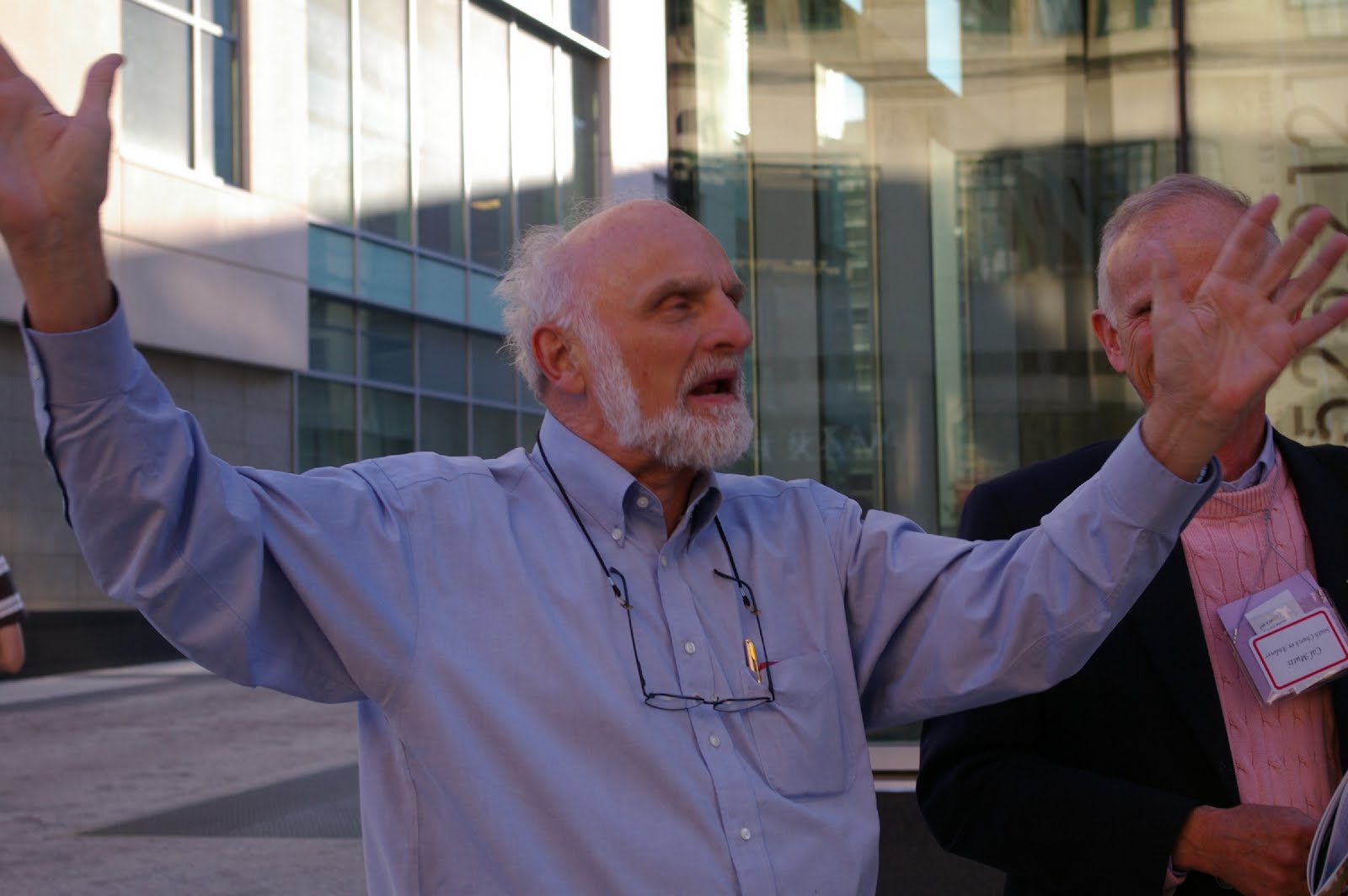

For Walter Brueggemann, the message was one of speaking boldly the things preachers often feel they cannot say.
For Krista Tippett, the message was one of listening more carefully, more deeply, to those who may disagree with us.
Both are vital messages to people engaged in the very public role of preaching in the nations’ congregations. They came in very different voices at the Festival of Homiletics this week in Minneapolis.
Brueggemann looks like what I imagine a Hebrew prophet would look like – tall, white hair (what hair there is), grumbly voice, piercing eyes. But he also has a sense of humor not often associated with those prophets. And he has a resume as a scripture scholar and professor that includes more than 50 books.
And as befits someone who looks and sounds like a prophet, today he used the story of Jeremiah, that dour profit of Israel, as his model for what happens to preachers when they are unable to speak hard truths. It tears at their guts, he said.
Or perhaps George Carlin and his seven words that could not be said on broadcast television should be the model, he suggested.
“George Carlin is not the last one who has a list of the unsayable,” Brueggemann said. “There is, for instance … you.”
It’s hard for today’s preachers to say that the war is stupid, that capitalism has failed in its excessive greed, that oil spill is a measure of Western technological hubris, that we have forfeited our democracy to a secret government protecting the wealthy. They can’t say that parents racing to get their kids to soccer practice and dance lessons will never win the rat race or that we can’t welcome the immigrant.
“It takes so much energy to remember what not to say,” noted Brueggemann. “What we cannot say (echoing Carlin) is that the body is fragile and smelly and cannot be otherwise. What we cannot say is that our body politic has the smell of death about it.”
OK, that’s harsh. And Brueggemann was quick to note that as a tenured professor, he has a lot more latitude to be harsh than the average pastor in the pulpit – what he called “such a dangerous place as you are every week.”
Then again, Brueggemann suggested, “you will get your self back in telling the truth before the authorities.”
Tippett is a soft-spoken radio host whose public radio program, “On Being” (formerly “Speaking of Faith”), explored people’s beliefs in a thoughtful, respectful way. And she is fascinated by how that kind of listening can lead not to agreement but at least to a deeper respect across ideological and theological lines.
“Listening is part of truth telling,” she said, reflecting on what Brueggemann had said. But it sure has a different feel to it.
She quoted Dietrich Bonhoeffer, the German pastor and martyr during the rise and fall of Nazism who said, “Christians are talking when they should be listening.” She noted that in the American political landscape in recent years, Christians have not been famous listeners.” (And those doing the speaking don’t have quite the same views as Brueggemann.)
So in an era when the pace of change has forced fundamental questions about life and relationships and authority and faith to the forefront, Christians have centuries of resources to draw on – but that requires asking questions with deep meaning and listening with sincere interest to the variety of answers.
“There is something redemptive and life giving that comes from asking better questions,” Tippett said, with the experience of one who has asked questions for years. The task for preachers, she said, is to “help people live the questions until they can be answered in their fullness.”
She talked about her conversation with Frances Kissling, the woman who for many years led Catholics for Choice. Now in retirement, Kissling is working on creating new relationships with her political opposites.
Two key questions Kissling asks:
What can I see that is good in the position of the other?
What troubles me in my own position?
This is not to reach agreement, Tippett noted. It is to understand better what the other – and you – believe. And a task for the church is to create the safe spaces where those kinds of conversations can take place. It goes back to that old Christian practice of hospitality.
Speak boldly, said Brueggemann, even about things you think you are forbidden from saying. Listen deeply, said Tippett, even to those you disagree with sharply. For both, a care with words and an honesty of spirit, a vulnerability of self and a tending to the soul are critical.


