Sunday, April 7, 2024

Delighting in Doubt

April 7, 2024, Christ Presbyterian Church - John 20: 24-30 

You can watch a video of the sermon here.

Good morning. My name is Thomas. I’m the one who asks questions.


When Matthew, Mark and Luke wrote their gospels, they just gave me a passing reference. They included me in the group Jesus called to be his closest followers. Nice of them to remember me. 


You’d think they could have at least told a bit more about me since some people said I was the twin brother of Jesus – or maybe a twin with one of his other brothers. Oh well.


But John … the most beloved of Jesus’ followers … John paid attention to me in his Gospel. And you know, the things John wrote about me are probably true of a lot of followers of Jesus. They may even be true of folks sitting in this church this morning.


There was the time Jesus’ friend Lazarus had died. Jesus wanted to go to Bethany to visit Lazarus’ family. Little did we know that he was also going to bring Lazarus back to life. All we knew was that Bethany was two miles from Jerusalem and some people there had wanted to stone him the last time he was in the area. When Jesus said he wanted to go to Bethany, I said, “Let us also go, that we may die with him.”


Now those may sound like brave words, but I just felt so committed to Jesus that I could not bear the thought of him going off alone to face people who wanted to kill him.


Not that I was ever afraid to ask him questions, you understand. On the night of his Last Supper, all sorts of unusual things happened. Jesus washed our feet and told us to serve others as he has served us.  He told us one of us would betray him. Us his closest followers! I could hardly believe that. 


He told us just as he loved us, we should love one another. Now that I understood. 


Then he said he was going somewhere to prepare a place for us in his Father’s house. Well, I was getting confused, so I asked Jesus, “Lord, we do not where you are going. How can we know the way.” And he patiently replied, “I am the way, and the truth and the life…If you know me, you will know my Father also.” 


I was not the only one who asked him questions that night. Peter and Philip and others asked him questions, too. That’s the way it was with Jesus. He knew he was telling us things that were sometimes difficult to understand, that he was asking us to live in ways that were different from what we were used to.  


So you can understand why I didn’t feel any hesitation about asking questions about this amazing story my friends told about Jesus appearing to them after that terrible day when the Roman soldiers nailed him to a cross. I was gone that evening – maybe they asked me to go out to get the groceries, which turned out to be a bad decision on my part. 


Jesus’ followers had all been gathered in a room on Sunday night, not sure whether they were also marked for death. They said Jesus came right through the locked door, breathed his spirit onto them and talked with them about forgiveness. I’m not sure what was more amazing … that they saw him after he had been killed or that he was talking about forgiveness so soon after his fellow human beings had treated him so despicably.


In any case, I spent the next week sort of on the outs with my friends. “We have seen the Lord,” they kept telling me. “Yeah, right,” I kept telling them. “Unless I can put my fingers into the nail holes in his hands and my hand into the wound in his side, I’m just going to keep believing that this is all in your imaginations.”


So when Jesus showed up again the next Sunday night and invited me to do just that, you can imagine how shocked I was. I guess my friends were feeling a bit smug right about then.  I did feel a little sheepish for being such a skeptic. 


But Jesus didn’t spend any energy making me feel bad. He invited me to have a tangible experience of his presence in my life. I needed that, and Jesus was just fine with that.


Well, thanks for listening. I think that other guy who’s preaching here today has a few things he wants to say. So I guess I’ll give him a chance.


+++++


Well, thanks, Thomas.


I know a bit about doubt and faith. I suspect many of us here do.


As many of you know, my first career was as a journalist. It’s a profession where one of the mantras is “if your mother tells you she loves you, check it out.”

I think that Thomas would have been a good journalist. He was curious, not afraid to ask questions. 

When I added ministry to my career in journalism, people would ask how I handled that change. I said I was straddling 
skepticism and belief. I thought that was a pretty good place to be. I still do.


We as a church community have said we think that is a good place to be as well. When we adopted our vision statement and articulated our values last year, one of those values is Doubt + Faith. 


Here’s how we explained it: “We humbly approach the mysteries of faith and complexities of life through continual learning. We encourage questions and curiosity.”


When we think about so many of the stories in the Bible, so many of the things we are asked to believe about God and Jesus, even the many things we are asked to believe about how we should live as followers of Jesus, it sometimes can seem a bit overwhelming. 

I think bringing a bit of skepticism to all that is not a bad idea. It forces us to think through the things we say we believe. 
The danger, of course, is when we allow skepticism to turn into cynicism. 


On the other hand, I find it helpful to remember that belief really means this is not something I can prove. I can believe in an idea; I can believe in a person. 
The parallel danger to skepticism turning into cynicism is belief turning into just blind faith. 


One of the things I learned from a pastor who was mentor to me is the phrase, “This is what I believe, but I could be wrong.” There is a resonance to that phrase that has allowed me to listen to what others believe with what I hope is an open heart.


The wonderful author – and Presbyterian minister – Frederick Buechner wrote an essay on doubt some 30 years ago and had this memorable line:

“Whether your faith is that there is a God or that there is not a God, if you don't have any doubts, you are either kidding yourself or asleep. Doubts are the ants in the pants of faith. They keep it awake and moving.”

And as Thomas mentioned, he was not the only one with doubts among Jesus’ followers. Remember when Mary Magdalene and the other women who had been to tomb and learned that Jesus had risen from the dead went back to tell the apostles?

Peter – among others – doubted what they said – ah, idle women’s tales - so Peter ran off to the tomb to see for himself. 

Peter’s doubts propelled him forward.  That’s what our doubts can do for us. We seek to learn more, to hear from others, to see what sense we can make of life.

Of course, sharing our doubts, our uncertainties with others can also cause a bit of tension. Keep in mind what the week must have been like for Thomas. 

His companions say they had seen Jesus and he told them he did not believe them. Yet they all stayed together in the midst of that. 

One of the things that I have come to value about life at Christ Presbyterian is how well we all stay together even though we bring a range of doubts and beliefs, of experience, of worship styles and musical preferences into this space. 

Here’s one example. There has been a movement over the last couple of decades to pay more attention to the reality that God is a being beyond any one gender. While many of us grew up thinking of God as a man and praying to God as a father, the language we use has broadened so much. 

Those of us in leadership here try to be conscious of that in our public prayers, in the lyrics of hymns, in our preaching. Yet we know that there are those among us for whom the more traditional ways of praying has deep meaning. 

We know that in churches less white than ours, the Father God language is central to an understanding of God’s care for them. We know that the fact the Jesus often called God “Father” – like he heard in Thomas’ references to Jesus’ Last Supper speech - helps inform many people’s prayers.

So here we work to hold so many traditions and styles in a place of respect. 

Here we work to make sure that people who continue to figure out what they believe have room for their questions and their doubts.

Here we hope that people who feel more anchored in their faith, in what they believe, can rejoice in that even as they recognize that others are still on a journey.

I feel so at home here because this is a place where I can straddle skepticism and belief with so many others. 

Many of you know that I grew up Catholic and the Catholic Church - and other Christian traditions - have a rich tradition of patron saints – heroes from the past who in some way are connected to a place or a profession or a cause in the present. You know – like St. Patrick is the patron saint of Ireland.

Well, I think if we had such a custom, Thomas would be a good patron saint for us here at Christ Presbyterian. Committed to follow the way of Jesus – even willing to stake his life on that conviction – yet always willing to ask questions, to live with doubts, to stay in community.

So thanks, Thomas, for setting an example. 

And thanks, people of Christ Presbyterian, for embracing Doubt + Faith.

Amen.


Sunday, March 24, 2024

An Invitation to the Future

To see a video of this sermon at Christ Presbyterian Church, click here.

Matthew 21: 1-11 

Each Gospel writer tells the story of this day in a little different way, but they all involve cheering crowds as Jesus rides a donkey down into the city of Jerusalem. There is so much excitement, so much hope. We join in the words “Hosanna” as palms wave among us. We think of it as a great cheer.

But actually, “Hosanna” is more than a cheer. 

The Hebrew roots of the word go back to Psalm 118 and mean “please deliver us.” There were lots of expectations being put on Jesus by the crowd that day. They had heard the stories of how he healed people’s bodies and their spirits, how he restored the alienated back to the community, how he proclaimed the good news of God’s love. He indeed was coming in the name of God.


There were a lot more people in Jerusalem that day than just the crowd cheering on Jesus. It was the season of Passover and people came from all over the known world to be in Jerusalem, to come to the temple. And Jerusalem - whose name emerged from words meaning the abode of peace, - was anything but peaceful, then or now. 


According to historians, Jerusalem has been destroyed at least twice, besieged 23 times, captured and recaptured 44 times, and attacked 52 times. It is divided today between Israelis and Palestinians, reflecting the deep divisions throughout that land. 

Our reading today ended with these words: “When he entered, the whole city was in turmoil.” The Gospel according to Mark has him briefly entering the Temple, foreshadowing the turning over of the money-changers tables in the days ahead. 

In the Gospel according to Matthew, Jesus after he enters Jerusalem, he calls it “the city that kills the prophets and stones those who are sent to it.” He wants to gather it like a hen gathers her brood under her wings.


In the midst of the turmoil, in the midst of generations of conflict past, present and to come, he held out hope for the city, hope for a humanity often torn by conflict that is fueled by hatred.


He entered in triumph but he was worried about the future – for humanity, for the city, for himself. And seeing beyond this week, he had glimpses of the brightness that would come with Easter. 


I think we tend to group all of the crowds in the various stories of Holy Week into one undifferentiated mass. I don’t think that is fair to this crowd on Palm Sunday. 


Look, we say, by the end of the week, they had turned on him, calling for his crucifixion. Yet there were so many people in Jerusalem, it is quite possible there were some very distinct crowds. 


Think of demonstrations we see in our nation’s capital – one day it is anti-abortion protesters, the next day it is pro-choice advocates. They are hardly the same crowd of people.


Besides, there are other traditions in Jerusalem during the Passover season that maybe offer us a key into how we might look at the crowds, the temple, the tensions - and find a way into the future.


Rabbi Sharon Brous, a wonderful voice who stands at the intersection of faith and justice in our country, tells of one of those traditions in her new book, The Amen Effect: Ancient Wisdom to Mend Our Broken Hearts and World.


She discovered it in what she described as “a Rabbinic teaching buried deep in a third-century Jewish legal compendium.” It is mostly about the measurements of the temple in Jerusalem finished in the century just before Jesus by Herod the Great – the one who was ruler of Judea when Jesus was born. But there is this one brief section that describes what the pilgrims to Jerusalem did when they arrived at the temple.


It's short. Here are the actual words from what is known as the Mishna Middot (mid’- dot)


“All who entered the Temple Mount entered by the right and went round [to the right] and went out by the left, save for one to whom something had happened, who entered and went round to the left. 


“[He was asked]: ‘Why do you go round to the left?’ [If he answered] ‘Because I am a mourner,’ [they said to him], ‘May He who dwells in this house comfort you.’


“[If he answered] ‘Because I am excommunicated’ [they said]: ‘May He who dwells in this house inspire them to draw you near again.’ ”


Rabbi Sharon extends that a bit further. When we are hurting, she writes, we step against the current. We know that feeling. In her words, “Every person who passed the brokenhearted would stop and ask, ‘What happened to you?’ 

“’I lost my mother,’ the bereaved would answer. ‘I miss her so much.’


“Or perhaps, ‘My husband just left.’ Or ‘I found a lump.’ Or ‘Our son is sick.’ Or ‘I just feel so lost.’”


“And those who walked from right to left – each one of them – would look into the eyes of the ill, the bereft, and the bereaved. ‘May God comfort you,’ they would say, one by one. ‘May you be wrapped in the embrace of this community.’”


What a great image. What a great reality for the people who came to the Temple. What a great reminder for us when we encounter someone in the midst of difficulties. 


“What is happening to you?” we might ask. “Why does your heart ache?” And then we listen. And we let them know that the community is around them.


Rabbi Chai Levy from a Jewish congregation in Berkeley wrote of this ritual: “The rabbis understood that those who experienced suffering or loss, those who have been shunned, and caregivers to the sick needed some emotional support.” 


And he asks: “How might we apply this idea to this time? How might we create similar ways to give and receive compassion and support and to acknowledge the grief, the losses, and the mental health crises experienced by so many this past year?”


And I might add, how can we amplify our hosannas – that plea for God to deliver us – to embrace those around us?

As Jesus entered Jerusalem, the crowd was with him. They knew that he had restored the alienated back to the community.  There were people with him throughout the week to come. They were looking out for him as well. 


They gathered with him at table, prayed with him in the garden. Simon from the North African city of Cyrene helped Jesus carry the cross. Luke writes in his Gospel that as Jesus and Simon went up the hill with the cross, “A great number of the people followed him, and among them were women who were beating their breasts and wailing for him.”  


Even as he was hanging on the cross, his closest followers were below and a criminal on the cross next to him reached out in admiration. And one of the Pharisees – Joseph of Arimathea – provided the place for Jesus’ burial. 


When we are hurting, we need a community around us. So many of you here know that, you have experienced it. So many of you here have been that community for people who need someone to care about them in the midst of hard times.


I surely know how important it has been to me. Whether it was disorientation from a broken relationship, support during a time of financial hardship, care in the midst of a health issue or embraces during times of grief, it was the community that sustained me. It was the people walking to the right that noticed I was walking to the left. 


When I think about Palm Sunday, about Jesus riding into Jerusalem, I think about it as the beginning of Holy Week. That’s a pretty common way to approach it. But I think the story takes us beyond the next seven days. 


I think the stories of Jesus, the stories of the people circling around the Temple, the stories of Jesus’ friends caring for him even as he cared for them, the willingness of Jesus to put his life on the line to challenge injustice all become invitations to us for our future.


We called our sermon series this Lent “come and see,” picking up on that phrase that occurs so often in the Gospels. Sometimes it was Jesus inviting people to see what he has to offer. Other times, people he encountered invited the ones they know to come and see Jesus. 


Our quest for Jesus does not end with Easter. And that’s why we end the series today thinking about what we are invited to do in the future.


It starts with each of us, of course. We have pondered how we might follow Jesus, what the risks are in doing that, how we seek justice and truth, where we might find healing. I hope there have been glimmers of insight for you on this journey.


But thinking about the future also involves us as a congregation. We spent a lot of time last year crafting a vision of who we are and the values that we hold. 


We say that “Christ Presbyterian Church envisions a world that is loving and inclusive. We unite with God to be a worshiping community without barriers, a sanctuary for all. We seek to follow Jesus by doing justice, loving mercy, and walking humbly with God.”

We say that the things we value are 

  • extending God’s love, 
  • holding doubt plus faith together, 
  • working to create a beloved community out of the diversity of thought, worship and experience among us, 
  • tending to our spiritual health, 
  • working for a more just world and 
  • caring for the earth on which we and our descendants live.  

Let me suggest that the work we as a congregation have done on this is our invitation to the future. 


It is something we can continue to celebrate on a day like this with joyful music and vibrant palm branches. 


It is an invitation that we can carry with us through this week that has the hardest stories of Jesus’ life and that we can carry together in the hardest times in our lives. 

And just as on Palm Sunday, Jesus got glimpses of the rising sun beyond Good Friday, we can put our trust in God’s love, in the Jesus as the Light of the World, in the Holy Spirit as energizing force that connects us all.


“Please deliver us,” the people cried out as Jesus rode by.


“Why does your heart ache?” the people in the Temple asked those passing by in sorrow.


“May you be wrapped in the embrace of this community,” they hear in the midst of their sorrow.


I will gather you like a hen gathers her brood under her wings, Jesus tells us all.


May it be so. May it be so.

Sunday, January 14, 2024

Beloved


To see a video of this sermon, click here.


Jan. 14, 2024 – Christ Presbyterian Church

Luke 3: 7-21


It was a little over 60 years ago when Rev. Dr. Martin Luther King, Jr. stood on the steps of the Lincoln Memorial and talked about the dream he had. This is the weekend when that speech shows up in many places. I am sure many of you are familiar with it.


But I’ll bet not many of you are not familiar with Gordon Gundrum, known by his nickname “Gunny.” 


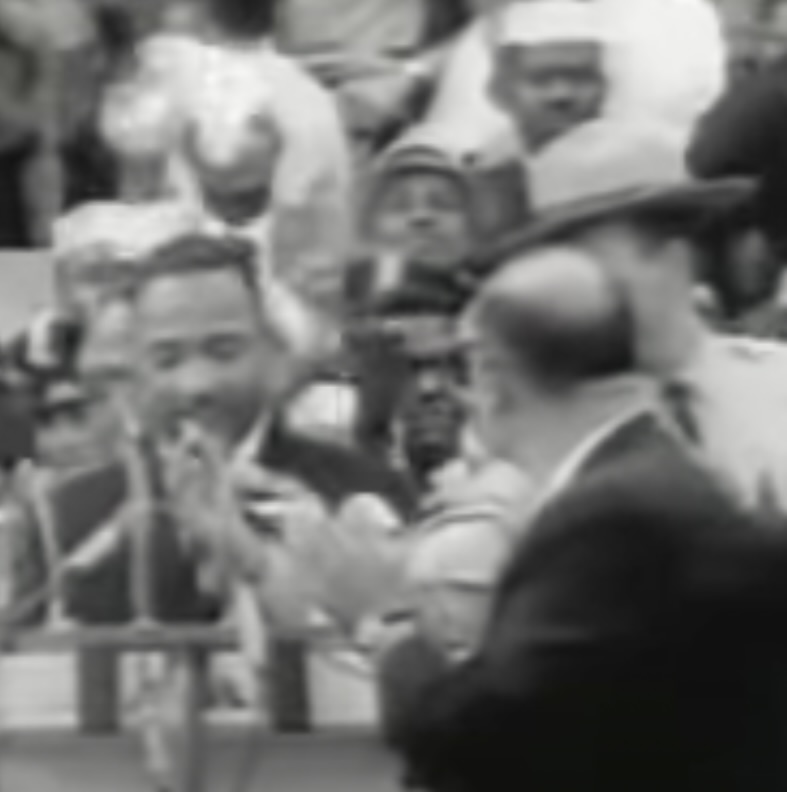
He was the National Park Ranger standing next to King at the Lincoln Memorial. You can see him in this picture – a rare white guy on a platform with lots of Black folks. 

I want to tell you a bit of his story because I think it can make a connection to the Gospel reading we just heard and to things we might do in our lives as we look at ways to follow Jesus. 


As Dr. King walked up to the podium, Gundrum realized that the microphones were aimed too high for a person of King’s 5-feet, seven-inches height. So he reached in and lowered each of the mics as King prepared to speak. 


Gunny Gundrum was 25 years old and had little familiarity with the diverse world that was now all around him.


Jonathan Eig, who just wrote an amazing biography of King, had a conversation with author David Maraniss last September at the Cap Times Idea Fest. He talked about getting to know Gundrum in his research for the book.


Eig said that Gunny “was very comfortable with the n-word.” He was from a big family from a rural community near Albany, N.Y. He told Eig he didn’t think of himself as prejudiced, but then again, he never met a Black person while he was growing up.


He learned more about prejudice in the Marines when he realized that he and his Black bunkmate could not go to the same restaurants near Paris Island in South Carolina. 

And he was not exactly culturally hip. When he saw a Black man with a beard approaching the stage at the Lincoln Memorial without making eye contact, Gunny stopped him and asked him for his pass, which the man said he had left in his hotel room. It was the famous singer, Sammy Davis, Jr. Gunny had not recognized him.


Now here Gunny was, standing next to, guarding, perhaps the most famous Black man in America at the time. King began speaking, quietly in that preacherly style he had. Gunny still worried that the mics were too low. King talked on. Finally, Gunny could not stop himself. He reached in front of King and lowered the microphones one more time. 


You can see his hand again reaching in front of King on this picture. He was amplifying King’s message to the crowd, to the world. A small act but symbolically a good lesson for all of us.


The speech took off. “I have a dream.” “Let freedom ring.” “Free at last, free at last, thank God almighty, we are free at last.” 


The crowd roared as King stepped away from the podium. And Gunny stepped right in front of him as they left the stage, making his body a shield for King.


Even though he was more focused on the crowd than on the speech, it still had a big impact on Gunny. Fifty years later, he told his hometown newspaper, “I took away from that day and that speech some idea of what the world should be and what we should all strive for.” 


He later became a New York State Police officer, and he told a reporter for the NBC Today Show, “Through what I learned that day, I think it made me a better policeman, a more fair policeman and I tried to practice that always.”


As Jonathan Eig thought about those moments when Gundrum wanted to make sure that King’s voice was amplified to the crowd, to the world that was watching, Eig told David Maraniss, “what I realized is that that was an act of love from Gunny, it's exactly the kind of Christian love that King talked about all the time.”


It was also the kind of love that John the Baptist and Jesus talked about.


It’s not that John sounds very cuddly at the beginning of today’s Gospel passage. “You brood of vipers,” he says to the crowd. We hardly ever say that to you here. It’s the kind of rhetoric we are more likely to hear in today’s political debates, but here it is in the Gospel.


Once John has the crowd’s attention, he goes all apocalyptic on them, describing God’s judgment in pretty vivid and unsettling terms. 


The crowd’s response? “What, then, should we do?” 


I can imagine that the crowd listening to Martin Luther King 50 years ago had the same question. 


I imagine that many of us here today when we look at all the issues facing our world, indeed all the issues facing our own individual and family lives, have the same question.


John offers some very concrete ideas to his crowd – share what you have, don’t get greedy, don’t extort money from others or make false accusations. As those who have studied the Gospel according to Luke note, justice is a recurring theme in his writings.


The song of Mary before Jesus’ birth – what we call The Magnificat – calls for justice for the poor.  After Jesus’s baptism that we heard about today, Luke tells the story of Jesus going into the desert for 40 days, then going to his home synagogue in Nazareth where he gives what amounts to his inaugural address based on the prophet Isaiah: 


“The Spirit of the Lord is upon me,
    because he has anointed me
        to bring good news to the poor.
He has sent me to proclaim release to the captives
    and recovery of sight to the blind,
        to set free those who are oppressed,
to proclaim the year of the Lord’s favor.”


Do you hear the echoes of that in John’s message? Do you hear echoes from that in the life and words of Rev. Dr. Martin Luther King, Jr.?


Then our Gospel story takes a hard turn. John points toward Jesus, amplifying the message that is to come. And it costs John his life. Before Luke gets to the baptism of Jesus, the Gospel writer tells us of John’s imprisonment. It’s as if he is saying, John’s work is done, now Jesus’ work is beginning.


And for Jesus to begin his work, he needs to stop and pray before he emerges from the waters of baptism and then God’s Spirit bursts on the scene: “You are my Son, the Beloved; with you I am well pleased.”


What then, are we to do?


Well, prayer is not a bad place to begin. No matter how we have tried to live out Jesus’ message in the past, taking time to pray provides an opportunity to assess and reassess whether what we have done still makes sense and whether what we might do now provides us a path forward.


I think that works both in our personal lives - and in how we choose to respond to the needs of those around us. Among the many messages Jesus gave us, stopping to pray was an action he often took.


Another thing we might do is remember that word “beloved.”

Yes, the Gospels tell of Jesus as God’s Beloved One in a very special way. But Jesus is not the only one beloved by God. 


So was John the Baptist. So are the people who have followed Jesus across the centuries. So are the Jewish people who proceeded Jesus and were known as God’s Chosen People. And so are we.


That sense of know that God’s love is with us – always – can carry us through some pretty hard times.


Just look at the things that happened in the months right after Dr. King told the nation about his dream. Four little girls were killed when white supremacists bombed a church in Birmingham, Alabama. President Kennedy was assassinated. The Black leadership in the struggle for racial justice began to fracture.


Dr. King knew what it felt like to be discouraged. Yet he pressed on. He had a sense of being one of God’s beloved ones, even when he recognized his own shortcomings and faced his own discouragements.


And still, Dr. King held out the vision of what he and others called the beloved community. There’s that word “beloved” again.


One of the people who went to that March on Washington in 1963 was Francine Yaeger, a 19-year-old Black woman from Chicago who took a train to DC for the March. She got a glimpse of that beloved community. Jonathan Eig, the author of that King biography, wrote this about her:


“As she got off the train and began walking in the direction of the Lincoln Memorial, she saw young people toting luggage for old people, daddies with their daughters on their shoulders, and mothers pushing babies in strollers. While people called Black people ‘sir’ and ‘ma’am’ and said ‘Good morning’ and ‘How are you?’ Everywhere, it seemed, guitars were strumming.”

Francine said to her best friend who had traveled to DC with her: “Florestine, this is what heaven’s gonna be like when we get there.”


But here’s another look at what the beloved community can be. It comes from Dr. Luther E. Smith Jr., a scholar of the works of Black theologian Howard Thurman, whose writings had a big influence on Dr. King. Smith spoke in 2019 at a conference on Thurman’s life and work that was held at Upper House here in Madison.


For Smith, living in the beloved community is not always such an idyllic place. 


He told about visiting a place that served people without homes in North Carolina. 


“So, it’s the homeless,” he said, “with all the aromas you get from people who have been living on the street. And some obvious signs of mental illness … But what I saw in that place was … an area for clothing with racks separating the clothing as if you walked into a department store. There was a place over here to help people deal with their disability benefits and other kinds of need they would have in terms of medical care. 


“There was artwork that many of them had drawn and their poetry as an expression of beauty that had come through them. I go into the living room and there are tables with tablecloths and china and they are being served four and five helpings of food.”


Smith said, “I felt that I had entered the realm of God. This was for me an experience of beloved community. Were there people still there addicted to drugs? Yes. Were some of the people serving wondering, could these people be doing better than they are? Probably yes. Do some of the homeless speak rough to one another? Yes.”


He concluded, “I would say that if we found ourselves requiring an understanding of the beloved community stripped of these dimensions of life, we’re always going to be disappointed in the picture of beloved community.”


I think John the Baptist understood that but still called people to be their better selves.


I think Jesus understood that, but still asked us to do the hard things that seem to go against our nature, like forgiving without limit and loving our enemies.


I think Martin Luther King understood that, knowing that it would take hard work, sacrifices, even death to bring that dream closer to reality. 


Across the centuries that people taken from Africa and sold as slaves in this country have been here, they have held out hope for freedom, for justice, for dignity. Their hopes and their persistence have been captured in a beautiful hymn that is often sung on this weekend. It’s called “Life Every Voice and Sing.” 


Today, we can sing it in solidarity with all those who are God’s beloved ones who have struggled across their lives while never giving up their dreams, the dream that Dr. King held out to us as a challenge 60 years ago.


Sing a song full of the faith that the dark past has taught us.
Sing a song full of the hope that the present has brought us.
Facing the rising sun of our new day begun,
let us march on till victory is won.


Gunny Gundrum took a small action to help Dr. King amplify that dream. We, too, can find ways to amplify the words, the hopes, the dreams for justice of those living on the margins in our time. 


So let us join together in singing this hymn. (This version is from Kirk Franklin.)

Sunday, September 3, 2023

No Place to Lay Your Head

If you'd like to see a video of today's sermon, you can find it here.

Matthew 8: 14-20

Jesus was not the only one who did not have a place to lay his head. 

This bronze sculpture by Canadian Timothy Schmalz portrays Jesus as person with no place to lay his head.
 
But then neither does David…nor Lizzie…nor Danny…nor Matt.

They are all people I have gotten to know during the last year at Christ Pres. They are all about in their 40s, They are all people who have been with us in our space at one time or another. They are people some of you have gotten to know as well. For today, I’ve changed their names.

They are people we have been able to help a bit with our Compassion Fund. And they are people who have taught me a bit about the challenges of being without a place to lay your head – at least without a place they could call home.

They are hardly alone. As of last Thursday, according to a story in the Wisconsin State Journal, the list of people who are homeless waiting for housing included 609 singles and 72 households with children. And those are just the ones on an official list.


Bryan Stevenson, whose book Just Mercy took readers inside his work to free people unjustly on death row and whose Legacy Museum in Montgomery, Alabama brings us face-to-face with the racial injustices across the centuries, talks a lot about proximity.

“If you are willing to get closer to people who are suffering,” Stevenson says, “you will find the power to change the world.”

That’s part of what I experienced with these four people. It’s part of what you experience when you eat with guests at Luke House or chat with people who come to the Community Fridge looking for food. 

Danny had been sleeping outside in parks along the lake – including right behind the church. He said that his wife had left him a while ago and brought his kids to Madison, so he came here to be nearby. 

A carpenter by trade, he was looking for a job, but had no place to live. He stayed at the emergency men’s shelter for a while, but then his backpack with his laptop and clothes was stolen, so he took to sleeping outside.

The day I met him at church, he was looking for clothes. All he had at that point, he said, was the tee-shirt and shorts that he was wearing. 

I took him over to the Beacon on East Washington – an amazing place that was packed with other people without homes looking for help – for housing, for a place to wash their clothes, for a place just to hang out for a while. They have been serving up to a record of 250 people a day during August. 

They told Danny they would find some clothes for him, but they were so busy and understaffed that it would take a few hours. He said he understood and would come back later in the afternoon.

A few weeks later, he stopped by to tell me his phone had been stolen. If you are trying to find work, you need a phone where prospective employers can reach you. So I used our Compassion Fund to get him a $50 smart phone and $50 in phone minutes. 

He was thrilled – and grateful. But then within a week, while he was sleeping at James Madison Park someone had stolen my old backpack that I had given him. There went his phone.

“I’m just not good at being homeless,” Danny told me. 

We went over to St. Vinnie’s to get a set of clothes he could wear to a job interview and he was off. He did not get that job – he needed a car to get to the various work sites, but now he has landed one at a company that does masonry restoration. I learned a lot about resourcefulness and persistence from Danny.

But he still has no place to sleep inside. The exhaustion of sleeping outside may well affect his ability to keep that job. I don’t think any of us are very good at being homeless. Even Jesus, after all, noted that he had nowhere to lay his head. 

Lizzie had a place to lay her head – sort of. When she first came to Christ Pres in late November, she and her 12-year-old daughter were sleeping in her car. She fled what she described as a bad situation in Chicago. She had been working with the Beacon and the Salvation Army to find a place to stay, but nothing had opened up. 

Family shelter
So the Compassion Fund got her a couple of nights in a motel until she could move into the Salvation Army Family Shelter on Milwaukee Street. That place – a former nursing home - can hold 35 families.

But life is never simple. She went to Chicago in December to try to get her 14-year old daughter to come back to Madison. She had gone back to Chicago with friends whom Lizzie did not trust. But Lizzie could not get back to Madison that evening and her daughter could not stay at the shelter because there was no adult with her and could I pick her up? No, I could not, for a whole variety of reasons. And it went on like that. 

Lizzie came here for Advent Vespers, sat in on a Bible study or two, tried to navigate dealing with two challenging teens. Through it all, she marked two years of sobriety. Finally, she decided the only thing she could do is go back to Chicago, even with all the troubles she faces there. 

From there, she keeps posting on Facebook about her faith in God to get her through all this and sending good wishes. 

I learned a lot about resilience and faith and determination from her.

I learned a lot about how overlapping issues can send you over the edge from David.

He had been an assistant professor at UW-Madison for six years, was a research fellow at Harvard, taught at Northwestern – and last fall was facing eviction, losing his car and potential arrest for failing to pay child support for his now 16-year old daughter to the tune of some $50,000.

What went wrong? So many things. 

He had emotional and physical disabilities that ultimately cost him his job. Part of what happened is he stopped opening his mail, would not answer or make phone calls and he was very hard to help since he wanted to do things his way. He had no income and his mother – who lived in another country - was draining her savings to support him where she could. 

Yet people did reach out to help. Our own Ron Konkol restarted the process to see if he could get Social Security Disability. The Aging and Disability Resource Center got him a case worker who could try to reestablish health care. The Tenant Resource Center provided an attorney who helped him get an extra month before eviction. Our Compassion Fund covered his car payment and insurance so he would not have his car impounded.

So many complications. At the end of September, a moving truck took his stuff to storage and – as best I can tell – he and his mother fled the country to avoid the warrant that was now out for him for failure to pay child support.

When you are living on the edge, there are not always happy endings.

Men's shelter
Matt is someone who has a better chance for a happy ending, but like Jesus, he has gone through this summer with no place to lay his head other than the Emergency Men’s Shelter near East Towne in the old Gander Mountain building.

That shelter now is setting new records for people staying there – 270 guests were jammed in there on Aug. 22, up from 210 earlier this summer.

Matt was married for 20 years. He and his wife had six kids – one of them now grown and living in Arizona. He worked as a custodian at St. Mary’s Hospital and Home Depot. But then two years ago, he and his wife got divorced.  He is still in touch with his kids. He is very close with his 16-year-old son. But life is so complicated.

Rent at the place where he was living was $1,300 a month, but the building was sold, and the new owner raised the rent to $1,700. Matt could not afford that. He sold his car to keep solvent for a little while. Now he was without a home or a car, so he went to the men’s shelter.

He got a job with the City of Madison Traffic Engineering Department painting lines on streets. But his shift was from 6 p.m. to 2 a.m. and the buses don’t run in the middle of night. So he’d sleep in a park after work, then catch one of the first buses at dawn back to the shelter. 

Folks had to be out of the shelter by 8 a.m., so then he’d go to a library, maybe getting a bit of sleep until a librarian woke him up and told him he could not sleep in the library. The Compassion Fund helped get him cab rides from work to the shelter for a few weeks, but now he is back on his own.

He worked with folks at The Beacon to try to find better housing. He applied for other, better jobs and got one at a downtown hotel as a maintenance worker. Rob Striker, who is on our Compassion Fund Committee, met a few times with him to give him some moral support. But in the meantime, Matt is still sleeping in the shelter.  

Here's a guy with no criminal record, dedicated to his family, working a tough shift on a city job, and bumping into one obstacle after another, including having cash from his paycheck stolen out of his wallet one morning at the shelter.  

It became clear to me even with a good job and a clean record how hard it is to find a place to live, even just a room he could rent in someone’s house. He is hardly alone. Finding housing is the biggest challenge for every agency that works with people without homes, domestic violence survivors fleeing their abuser, people returning from prison, immigrants arriving in our city.

The time I spent with Danny and Lizzie, with David and Matt drove home to me so many of the challenges people face when they are trapped in poverty. No place to live, no car for transportation, no job because they have no phone, emotional illnesses, fractured relationships. 

One of my heroes is Fr. Greg Boyle, a Jesuit priest who 35 years ago in Los Angeles started an organization called Homeboy Industries that works with gang members. 

In his 2017 commencement address at the University of Notre Dame, Fr. Greg told the graduates that a healthy community stands “in awe of what the poor have to carry rather than stand in judgment of how they carry it.” He added that “the measure of our compassion is not in our service to those on the margins but to see ourselves in kinship with them.”

When we encounter the poor, those with no place to lay their heads, we are in a way encountering Jesus.  So many people here know what that means. For some, it is the way you reach out to help. For others, it is how you have experienced the challenges of poverty yourselves. 

One of the great blessings we have here at Christ Pres is the Compassion Fund that has been able to help people both within our congregation and those in the wider community. 

A bequest from a member a few years back has given us the resources to work with. That money will not last forever, of course, and our Deacons Compassion Fund committee works hard to use the funds both generously and wisely. 

That empty plate that the homeless Jesus is pointing to gets filled and refilled thanks to the work of people here.

But we do more that provide resources. In that Gospel story we heard today, Jesus healed people in their distress. That inspired others to follow him. I think for many of us, that inspiration propels us forward as well. 

We are among those who try to love and to serve our city. We cry out for justice. We reach out to those in need. We let their lives affect ours. We experience proximity just as Jesus did.

So let us join together in a hymn. It’s #351, “All Who Love and Serve Your City.” We’ll sing verses 1, 2 and 4.