Saturday, October 31, 2009

Hebron: The City of Conflict

Hani Abuhaikal and Walid Halawah are each trying to build a future for Hebron following different paths. Yet each path offers a glimmer of hope in this place that embodies the deep animosity between Palestinians and Israelis who battle over the major city in the southern part of the West Bank.

We call it "the city of conflict," Walid told us -- a sharp difference from Bethlehem's motto of "City of Peace."


This division between the children of Abraham plays out in the shadows of the place honored by both Muslims and Jews as the burial site of Abraham and his wife, Sara, as well as Isaac and Rachel, Jacob and Leah. Even here, at this holy site -- one part mosque, one part synagogue -- Muslims and Jews enter the building over the Cave of the Patriarchs from different sides, at different times, through different security systems. They are kept apart at the tomb of their spiritual ancestor.


This mosque was the site of a massacre that is etched deep in the consciousness of the Muslims here. It was on Feb. 25, 1994, that an Israeli settler, Baruch Goldstein, entered the mosque during dawn prayers and strafed the worshippers with bullets from a submachine gun. He killed 29 of them.


But embedded in Jewish consciousness is another massacre 65 years earlier, when a group of Arabs in Hebron killed 67 Jewish residents and burned synagogues and homes. Other Arabs there provided shelter for the 450 Jews fleeing the violence.
A city of conflict indeed.

Our guide through Hebron on Oct. 30 was Michael Hiller, who just finished a three-month tour there with the Ecumenical Accompaniment Programme in Palestine and Israel (EAPPI), a project of the World Council of Churches. EAPPI volunteers from around the world serve as observers at the hot spots in cities like Hebron. He was sent here by the Evangelical Church of Southwest Germany.


He described Hebron to us -- the biggest city in the West Bank, with a population in the city estimated at about 200,000, in the region of somewhere around 650,000. It is the commercial center of the West Bank, tracing its history back nearly 6,000 years, located on the pilgrimage route to Mecca for Muslims, on the trade route between Damascus, Syrian and Cairo, Egypt. It is a predominantly Muslim city, with virtually Palestinian Christians presence here.


But there are six Israeli settlements that have grown up here since 1970, including one in the central vegetable market. Hiller reminded us that under international law, it is illegal for an occupying power to settle land in the occupied region. Yet that is precisely what has happened here as well as at many other places in the West Bank.


We stood with Michael at one of the borders between the two political regions in the city -- H1, which is for Palestinians, and H2, which is called a closed military zone -- the areas where the Israeli settlers live.
But even in the H2 zone, Hiller told us, there are 40,000 Palestinians. There are about 500 Israelis there, with about 1,500 Israeli soldiers providing security to them and controlling he comings and goings of the Palestinians.

Here as in so many other places in the West Bank, the Israeli control system of check points forces Palestinians to take circuitous routes to work and to school.
One particularly striking example of the impact of this control occurred at an intersection near the Ibrahimi Mosque. This street is within the controlled zone and both Palestinians residents and Israeli settlers use it. The Palestinians must approach the checkpoint on the left side of a concrete barrier that runs along one part of the street. The Israelis and international visitors like us may use the main part of the street. They are then funneled into the separate entrances to the mosque, where Palestinians must go through three security checkpoints. By the time he sets inside, Walid Halawah told us, he feels like "I'm not entering a holy place. I'm entering an Israeli military zone."

At that check point near the mosque, there is an Israeli community center named after Yosef Yitzhak Gutnik, a wealthy Australian who has provided significant financial support for the Israeli settlements in Hebron. Loudspeakers on the roof blast Israeli music all day long, disrupting the call to prayer from the mosque and making life miserable for the three Palestinian merchants at that checkpoint as well as the Palestinians walking to the mosque for prayers.


The Palestinians see all this as a concerted efforts to push them out of central Hebron, to let the Israelis create a large area that connects all of their settlements into a contiguous community.
Because of the proximity of Israeli settlers and Palestinian residents along with the military control exerted by the Israeli army, tension is always high here.

The settlers in Hebron, a majority of whom come from the U.S. and Europe, have a reputation for being particularly aggressive. The settlers in the downtown area toss their garbage down on the vegetable market, which is now protected by nets that catch the garbage (see photo above). There are many verbal confrontations.

The once thriving commercial area along Al Shuhada Street is now block after block of closed stores, some with Stars of David painted on the doors signifying the settlers intent to claim them.

Hebron -- a city of conflict in desperate need of the hopeful initiatives of people like Hani Abuhaikal and Walid Halawah.

Thursday, October 29, 2009

Holy sites, hard realities

It has such a richness in its name - Nazareth, the village where Jesus grew up. But Nazareth in 2009 is a far different place than it was 2,000 years ago. It is a place that mixes holy sites with some of the hard realities of contemporary Israel.

There are the well known holy sites, like the Church of the Annunciation, commemorating the story of Gabriel, God' messenger, telling her that she would conceive a son who would be God's ultimate revelation to humanity.

But just down the street is the convent of the Sisters of Nazareth, a French order of Catholic nuns who came to this city in 1855 to teach Palestinian girls.
About 30 years later, in 1884, a worker cleaning a cistern discovered the underground remnants of what has been identified as a first century Nazareth home and burial crypt.

Sr. Marguerite, who guided us through the passages beneath the convent, told us there were about 40 homes in Nazareth in the first century. While there is no evidence that this was the home of Joseph and Mary and their son, Jesus, their home would have been similar to this one. And since the families were pretty well interconnected, it is reasonable to assume that Jesus at least visited this home.


Off to one side, deeper in the earth, is a tomb honored over the years as "the tomb of the righteous one." Again, there is no evidence who that might be, but the speculation of course runs toward Joseph, Mary's husband, known as "a righteous man." (Matthew 1:19) Sr. Marguerite was careful not to make any claims in that direction, but the twinkle in her eyes offered the tantalizing possibility.


We darted through a rare rainstorm up the hill to Nazareth Village, a modern re-creation of a first century Jewish village. But the real story of Nazareth came over an authentic lunch -- lentil soup, cabbage salad, apples with date dip -- we shared with Gosayna Karam, a staff member at Nazareth Village. Both she and her husband grew up in Nazareth, they were married in a grand ceremony in the Church of the Annunciation and they are raising their four children there. But she spent part of her life growing up in Australia and their first three children were born in the San Francisco area.


She talked about the mixed blessings of life for Palestinians in Nazareth. She values the closeness of family ties, which means that even when someone is unemployed, they are cared for by their extended family. There are no homeless people here, she said.
The Israeli health care system covers everyone, even those without jobs, Arabs and Jews equally.

But the education system - that is another story. Schools receive four times the amount of government aid for a Jewish child as for an Arab child. The curriculum is dictated by the government and ignores any sense of Palestinian history.
While Gosayna appreciates that her children are learning four languages -- Arab, Hebrew, English and French -- she is dismayed by the teaching style that emphasized facts but not learning. She lamented classes of 40 children all expected to look straight ahead, teachers who yelled rather than encouraged, homework for even young children that stretches into four hours a night.

Nazareth is a predominantly Arab village -- now with a Muslim majority, but still with a significant Christian presence. A new city just up the hill - Nazareth Illite -- is a Jewish city with far better facilities provided by the government.
But at least here, the existence of Palestinians is acknowledged. When we talked about our visit to Biram, the Palestinian village that has virtually been obliterated from Israeli consciousness, she told of many other Palestinian villages that are no longer acknowledged by the Israeli government, which means no more building permits, no electricity, no running water. She said that Palestinian aid organizations work to help residents there.

Such is the story of Nazareth. The tourists come to visit holy sites. Doing the work Jesus talked about -- embracing all across social and political boundaries, caring for those in need -- goes on in less visible places.

It's not all that different from what Jesus did in those relatively obscure years he lived in Nazareth, doing the work of God even when he was not being noticed.

You can't get there from here

Our journey from Nazareth through Jericho to Bethlehem provided a classic illustration of the absurdity of travel restrictions between the West Bank and Israel.

Yes, I know the Israelis would say there is nothing absurd about protecting there citizens from the threat of terrorism. But on this day, the absurdity played out in a journey that went on far longer that it needed to.
We drove from the Galilee region down the Jordan River Valley, entering the West Bank with just a nod from George, our driver, to an Israeli guard at a check point. So far so good.

But when we got to Jericho, we had to bypass the first entrance to the city -- just a couple of minutes into downtown had we been able to take it -- to the only open entrance several miles down the highway. We went through an Israeli checkpoint where the soldier said he was just checking to make sure we were all wearing our seatbelts. (We were.)

The main issue here was to make sure no Israeli citizens entered into this West Bank area which is under the control of the Palestinian Authority. Then we came to a Palestinian checkpoint, where George and the guard had a brief but friendly conversation.


When we left Jericho, we could take a direct route to Bethlehem, which is also in the West Bank. We had to head out past the same two checkpoints, although now both were unguarded. Then we had to drive to Jerusalem, enter Israel (another checkpoint) and drive to the main entrance to Bethlehem from Jerusalem. There we were waved off because there was an Israeli celebration at Rachel's Tomb near that checkpoint and the checkpoint was closed. ("When they celebrate, we suffer," said Rev. Mitri Raheb when we arrived at the International Center in Bethlehem.)


The next nearest entrance to Bethlehem had about a two-hour wait, so George drove a circuitous route to a third checkpoint that would let us in through Beit Jala, a city adjoining Bethlehem. We could get in that way, but George pointed out that as tourists, we could not leave through that checkpoint.


What should have been a couple of short journeys into Jericho and into Bethlehem became extended and exasperating adventures in life in an occupied territory. For us, this was just one adventure. For the residents, it is a daily reality.

Wednesday, October 28, 2009

Wandering along the Sea of Galilee

We were seated in a semi-circle on the hill where tradition has it that Jesus spoke the phrases known as the Beatitudes to the crowd that had gathered to hear him.

Behind us was the Sea of Galilee, that body of water that is so central to the Gospel accounts of Jesus' life. Down the coast we could see Capernaum, the village that served as Jesus' base of operations for so much of his ministry. Up the hill a ways was the Church of the Beatitudes, where people were participating in a Catholic Mass.
Bonnie Van Overbeke read the Beatitudes as Matthew recounted them: "Blessed are the poor in spirit, for theirs is the kingdom of heaven. Blesses are those who mourn, for they shall be comforted ... Blessed are those who hunger and thirst for righteousness, for they will be filled ... Blessed are the peacemakers, for they shall be called children of God..." (Matthew 5: 1-12)

There were tourists milling all about, of course, but for these few moments, we had this beautiful space to ourselves, letting the spirit of those words sink into the core of our beings. A bird sang from one of the bushes behind us.

There were other moments like that on this day as we traveled along the shore of the Sea of Galilee. At Capernaum, you can see a church built over the excavation of the house of Peter, the apostle. You can walk into the fourth century synagogue built on the foundation of the first century synagogue where Jesus came to teach. But for me, the stunning moment of the day came under a banyon tree that rises grandly above the Galilee shore. I sat under the tree, watching the water, imagining the times Jesus would have walked along this shoreline letting his spirit connect with God. It was a sacred moment.

Down the road a bit is the Church of the Multiplication of the Loaves and Fishes. This commemorates the story of Jesus feeding a crowd of 5,000 with five loaves of bread and two fish. (told in Matthew 14: 16-21) Nearby is the Chapel of St. Peter's Primacy. These are both in an area called Tabgha, which means Seven Springs. There is wonderful access to the Sea of Galilee behind St. Peter's Chapel. This spot commemorates Jesus' appearance to his apostles after his resurrection when he came ashore, ate fish with them and told Peter to "feed my sheep," which some interpret as giving Peter primacy among Jesus' closest followers. Both of these stories use food to show how Jesus opened people up to a spirit of hospitality and generosity.
We stood near the shoreline as Nancy Baumgardner played her recorder and we sang the wonderful hymn about Jesus coming down to the lakeshore to invite the fishermen to follow him. "I have abandoned my small boat," we sang. "Now I will seek other seas."

Two more stops. We saw a first century fishing boat similar to the one those fishermen would have used. It has been restored and is displayed at a museum near Magdala, the home village of Mary of Magdala. Then we ended the day at the point south of Tiberius where the Jordan River flows out of the Sea of Galilee. This is honored as the spot where John baptized Jesus. As darkness crept over the river, people dressed in white garments gathered along the bank to re-enact their own baptisms -- or perhaps to be baptized for the first time. Here was one group where the baptizer wore a cowboy had. One way down the river were a group of African men and woman being plunged into the water. The other way, a group of Mexican-American Catholics were standing barefoot in the water as a priest led them in a renewal of baptismal vows.

Somewhere ... beyond the rows of tour buses, the ever-present gift stores, the variety of legends about each place ... somehow along this shoreline, the spirit of Jesus is still vibrant, calling people to step out of their boats, share a meal with someone in need and live in the way of the beatitudes.

The hidden story of Biram

From the entrance, it just seems like a pleasant national park area. You pay a fee, park your car and meander up the rock steps to the site of an ancient Roman temple that had been converted into a synagogue by the Jewish community in the third century in the Christian era. The ruins of another synagogue are nearby. A sign an the entrance to the park tells part of the history.

What it leaves out are the hundreds of years when this village of Biram was the home of the Melkite Christians, generations of Palestinian families who cared for this land. One of them was the Chacour family. A son of that family, Elias -- the founder of amazing educational institutions at Ibillin, now the Melkite bishop of Israel -- wrote about that point in history that gets only a glancing reference in the tourist brochure.

"During the War of Independence (1948), the villagers were evacuated," the park brochure says. In Chacour's book, Blood Brothers, he offers a lot more detail.

First the Israeli soldiers, moving to take control of their newly formed nation, showed up in Biram and took up residence in many of the family homes, including that of the Chacours. The family slept on the roof. Then in the spring of 1949, the military commander told the village elders that they needed to evacuate for a few days. Leave the keys with us, they told the elders, nothing will be disturbed.

So the families "evacuated," as the brochure said. But they never again would be allowed back in their homes. After extensive legal battles, with two rulings from the Supreme Court that the army should let them return to their village, the commander told the Biram residents who had been staying in a nearby village that they could return on the morning of Dec. 25, 1951. But as they approached in joy that Christmas morning, the Israeli artillery opened fire on the village, destroying virtually all of the home, damaging the church.

So as we walked deeper into the park, we came to the church, rebuilt in the 1960s by some of the young men who had been born in Biram. Chacour tells of helping them "rebuild a symbol of hope for the Palestinian people." The church is now used for Christmas and Easter ... and for funerals. This day, our group from Wisconsin and Mississippi stood outside the church. Nancy Baumgardner took the stairs up to the roof and rang the bell.

If there is a glimmer of life at the church, the rest of the village of Biram is a monument to destruction. The ruins of the old homes dot the landscape. You can see the door frames, a grill, a window. But mostly, you see weeds overgrowing the piles of stone rubble left by the artillery barrage of 1951.

At the edge of the village is the Chacour home, just a bit down the road from where Eilas' parents are buried. In the book, Elias tells the story of his older brother Rudah, who came home one day with a rifle back in the late 1940s when he heard that the Israeli soldiers would be moving in. (It was Rudah and his son who took me on my first tour of this village in 2004). When their father, Michael, saw the gun, he erupted in a rare display of anger: "Get it out of here! I won't have it in my house." He paused, then said more calmly: "We do not use violence ever. Even if someone hurts us."

There is a rich history of family love and tragic displacement in these stones. It's a history that most visitors to this Israeli national park never encounter.


Monday, October 26, 2009

It's one part pilgrimage to holy sites. It's one part bonding with friends we know. It's one part exploration, planting seeds for new friendships as we learn about life in Israel and Palestine in a time of tension.

Eight of us are leaving today to spend 12 days in Israel/Palestine. Four of us have ties to Memorial United Church of Christ in Fitchburg -- Bonnie Van Overbeke, the former pastor there; Nancy Baumgardner, a very active member; Petra Streiff, the former parish nurse who is now associate pastor at Swiss UCC in New Glarus; and me, the current full-time pastor. Memorial has a partnership with Christmas Lutheran Church in Bethlehem, where we will all be worshipping next Sunday (Nov. 1). Joining us are two couples from Mississippi -- Rims and Judy Barber (Rims in Bonnie's brother) and their friends Glenn and Betty Gentry.

We will arrive in Israel on Tuesday afternoon and head to Nazareth. We'll see various Biblical sites around the Sea of Galilee; visit Biram, the hometown of Elias Chacour, an amazing Melkite archbishop who works to cross the barriers among Christians, Muslims and Jews; and spend some time at Nazareth Village, a recreation of the first century village where Jesus grew up.

We will head to Bethlehem on Thursday and spend several days there, including time chatting with Rev. Mitri Rabeb, the pastor at Christmas Lutheran Church and a good friend.
On Monday, Nov. 2, we will head east to Eliat on the Red Sea. We will visit the ancient city of Petra and on the way back to Jerusalem after a few days, we will stop at the Dead Sea and visit Qumran, the site of the discovery of the Dead Sea Scrolls.

We arrive in Jerusalem on Wednesday evening, Nov. 4. We will visit the holy sites there, spend time at Augusta Victoria Hospital and meet a wide variety of people.
And then it's back home.

I'll file updates and photos as I can along the way.

Peace. Shalom. Salaam.

Tuesday, June 30, 2009

Videos of the demolition

Watch Michael Magness make an assault on Tuesday on the crumbling - but very tough shed -- with a tractor. Then watch our gang on Wednesday make the final push to topple what remained of the structure.


Saturday, June 27, 2009

Thoughts from the students


One of the most amazing parts of the trip for me was a conversation in the kids' room at the hotel we are at in Cape Girardeau, Missouri. I wanted to hear a few of their thoughts about he experiences of the week. They talked and talked and talked. Clearly this week had a profound effect on all of them.

They talked about the bonding they had with one another, starting with the afternoon at City Museum in St. Louis on the way down and continuing through the week. They talked about the bonding and their new friendships with our colleagues from Cedar Hills UCC in Portland, who shared the week with us. They were happy about the good food they got during the week, about the experience of living in a couple of trailers at Back Bay Mission in Biloxi.

They were very appreciative of the stories they heard from the people they were helping in Biloxi -- at houses, at the meal program, in the service areas at Back Bay. They were very excited about being part of the worship service Wednesday night at Missionary Baptist Church in Biloxi, a traditional African-American congregation. They liked seeing the French Quarter, Bourbon Street, the various neighborhoods in New Orleans. The bad parts? Long car rides, one bad restaurant stop along the way, the heat.

They were struck by the contrast of huge casinos right across the street from one of the poorest neighborhoods in Biloxi. They wondered how many houses could have been built for the cost of the huge guitar sign outside the Hard Rock Cafe and Casino. One of them said they expected to see poverty in Biloxi, but once they met the actual people living in poverty -- living in a tent, struggling with disabilities. "I never thought about the stuff that made people poor," Austin said.

That's the kind of insight that these kids gained on this trip. I am so proud of them. They were easy to travel with, extraordinarily hard working, lots of fun and very thoughtful. Thanks to all who helped make this happen.

Heading home

Greetings from Cape Girardeau, Missouri, where we are spending the night on our way back to Madison. It has been a great week for all of us.

We spend Friday seeing some of the aftermath of Hurricane Katrina in New Orleans. On the way from Biloxi to New Orleans, we drove along the Gulf Coast, including an amazingly beautiful and haunting trip through the Bayous to the southeast of New Orleans. We got a briefing on the situation from a woman at Good Shepherd UCC in Metarie, who works with relief groups. She took us over the Ninth Ward and the Lower Ninth Ward to see what is happening there now.

In the Lower Ninth, one of the poorest areas of the city, it is striking how few homes have been rebuilt four years after Katrina. We did see the very modern and sustainable homes being built with help from the Brad Pitt Foundation. In the main Ninth Ward, which suffered a bit less destruction during the storm, we saw Musicians Village, a reconstruction project of the Marsalis family to help keep musicians in New Orleans by helping them with housing.

Then it was down to the French Quarter, dinner in Metarie at a wonderful oyster restaurant. We were on the road on Saturday by 9 a.m.

Friday, June 26, 2009

A slide show our week at Back Bay Mission

We posted a link to our photos earlier, but we have added many more since then. They are all on the earlier link, several posts down the blog, but here they are as a slide show.

Wednesday, June 24, 2009

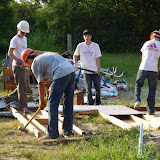
An old shed bites the dust

For most our crew, Tuesday and Wednesday invovled destruction. And they loved it.

"Demolition seems like the opposite of Back Bay," said Elliot. But as our group learned, it's also an important piece of helping out people here.

In this case, the group was tearing down a large shed that had been used as a house for a while. The owner, JW, had led some relatives live there after Katrina hit in 2005. It eventually became used as a drug house. Once officials got wind of this, they condemned the building and required JW to tear it down.

The thing is, JW has his own Katrina story. He's a man in his late 50s, the kids estimated. His wife is from Scotland. They got married just after Katrina and he was helping fix stuff that had been damaged by the storm. He was going through several small heart attacks that week and finally went to the hospital in Gulfport, where they diagnosed what was going on and eventually did bypass surgery. But he said he had been unconscious for 28 days and diminished circulation led to the amputation of a leg and several fingers. So he was in no condition to tear this structure down himself.

Back Bay came to this assistance and our folks were the assisters. Michael and Beth, the four guys -- Adam, Austin, Elliot and Phillip -- and Janine went out on Tuesday to begin the work. They stripped off the tin roof and began removing pieces of the structure. But the temp was setting new records for Biloxi in June, cracking 108 degrees where they were working on Tuesday. And as flimsy as this structure looked .. well, as Austin said, "Now that we're trying to tear it down, it seems a lot sturdier."

Michael tried to pull the whole thing down with a tractor, but that did not work on Tuesday. Eventually, the crew came in from the heat with a plan for Wednesday.

There was one casualty the first day. Phillip tried to break out what seemed to be fiberglass, but actually was real glass and got some cuts in the process. The second day, he really did get covered with fiberglass and he had the experience of a huge cockroach crawling up his leg and onto his bare stomach. But mostly, the casualties were tee-shirts drenched sweat.

So the gang got up before sunrise on Wednesday and left the trailer at 6:15 a.m. to do their work in the cooler part of the day. By 8:30, the structure was down. But getting it down took a combination of pulling with the tractor and guys lunging toward it like the front line of a football team. "All" that remained was the cleanup. That was done by 12:30 and the crew headed back for lunch, showers and a trip to the beach.

And then there's a footnote. At that point in the day when everyone was feeling pretty dragged out and discouraged, JW came out with something for us to read. It went like this:

TO: You
DATE: Today
FROM: God
SUBJECT: Yourself
REFERENCES: Life

This is God. Today I will be handling all of your problems. I do not need your help. So have a nice day. I love you.

P.S. And remember ...

If life happens to deliver a situation to you that you cannot handle, do
not attempt to resolve it yourself. Kindly put it in the SFGTD (something for God to do) box. All situations will be resolved, but in My time.

Once the matter is placed into the box, do not hold onto it by worrying about it. Instead, focus on all the wonderful things that are present in your life now.

If you find yourself stuck in traffic, don't despair. There are people in
this world for whom driving is an unheard of privilege.

Should you have a bad day at work, think of the man who has been out of work for years.

Should you despair over a relationship gone bad, think of the person who has never known what it's like to love and be loved in return

Should you grieve the passing of another weekend, think of the woman in dire straits, working twelve hours a day, seven days a week to feed her children

Should your car break down, leaving you miles away from assistance;, think of the paraplegic who would love the opportunity to take that walk.

Should you notice a new gray hair in the mirror, think of the cancer patient in chemo who wishes she had hair to examine.

Should you find yourself at a loss and pondering what is life all about, asking what is my purpose? Be thankful. There are those who didn't live long enough to get the opportunity.

Should you find yourself the victim of other people's bitterness, ignorance, smallness or insecurities, remember, things could be worse. You could be one of them!

Should you decide to send this to a friend, thank you. You may have touched their life in ways you will never know!

Now, have a nice day!
God

Drama in the front office

Kirsten spent part of Tuesday and Wednesday helping out in the reception area at Back Bay Mission. This is where people in need of help come. Sometimes the folks at the reception desk can direct them to services. Sometimes they can give them the things they need. Often, they connect them with one of the caseworkers at Back Bay.

Back Bay Mission is the only service agency in Biloxi (population about 50,000) that offers daily emergency assistance to people, so they get a steady stream of visitors.

Kirtsen said she loved this part of the trip because she was actually getting time with the people who live here. And on Tuesday, she was part of an extra measure of drama.

One of the gentlemen who came in was a frequent visitor to the mission. He was sweating a lot this day -- not unusual as the temp was climbing to 100. Kirsten talked with him a bit and eventually he went back to see a caseworker, where he told about his chest pain and shortness of breath. She determined that the man was having a heart attack and called 911.

Devastation remains along the coast

Tuesday night, we took a four-vehicle caravan with all 26 of us from both congregations along the Gulf Coast to get a little sense of the devastation that still exists after Katrina. It's an odd sense. There is a fully functional mall -- Dillards and all - right next to empty lots. Someplaces there are long stretches of grass growing over And then there are businesses and condos that are in full gear. There are almost no homes rebuilt along this stretch.

We went as far west as the University of Southern Mississippi Gulf Park. The dorms and administration there still stand empty, windows blown out, blinds dangling. You can peer inside and see things that have been thrown around the rooms. This is also the site of a sprawling Friendship Oak, that dates back to about 1487.

Do justice, love kindness, walk humbly with our God

Shari Prestemon's predecessor at Back Bay Mission came there with a well-defined task -- close the mission. The divisions of the civil rights movement in the 1950s and 1960s had split local churches. Back Bay's activism on behalf of the had created controversy in Biloxi. There were no longer any UCC congregations in Mississippi. The mission appeared doomed. But, Shari noted with a smile, her predecessor "failed." Back Bay Mission experienced a rebirth. And now it tries to live out the words of the prophet, Micah -- to do justice, love kindness and walk humbly with God.

Shari talked about the kindness part -- the food pantry, the outreach workers, the housing reconstruction. And she talked about the justice part -- asking why people faced oppressive conditions and then trying to change those conditions. "When you go home," she told our groups, "think about the justice issues in your back yards and then figure out what you can do about them."

Monday, June 22, 2009

A photo view of our week

Back Bay 2009

A day of painting

We started out this morning putting the final (we thought) coat of paint on the ceiling of a new house that is about to be turned over to a woman who has been displaced in the last four years since Katrina. "You know how excited you are when you move into a new house," said Bob, our crew leader from Back Bay. "Just imagine what it's like if you have had no home for the last four years."

But, of course, things did not go totally as planned. The paint was not quite dark enough and some slotches were showing through. So this afternoon, all five of our teens plus Michael and Janine went back to put on a second coat while Mary Kay, Beth and I, along with Allison from Cedar Hills UCC went to Winn Dixie to buy groceries for the next few days. When everyone gets back, we'll head to the Gulf shore and do a bit of swimming before dinner.

The temp, by the way, is pushing 100 and the humidity is, shall we say, noticeable.

Off the road – at last

The Memorial crew rolling into Biloxi at about 8:15 Sunday night. That was just about 11 hours after we left Parkway UCC in St. Louis, our home overnight on this journey. Other than being a long trip, we all had a good time, shifting the configurations of who rode where and who drove which car several times along the way.

A few of our group checked out early. Others stayed up to wait for our partners from Cedar Hills UCC in Portland, Ore. Part of their group was flying into New Orleans on a late flight, so they arrived in Biloxi at midnight and quietly (really) settled into the trailers with us.

Along the way, there were some highlights:

* Climbing outside on metal structures at the City Museum in St. Louis, "sweating half our body fluid out," according to Phillip Bessemer.

* Riding the tram to the top of the Arch, looking out over the Mississippi River on one side and downtown St. Louis on the other. It was an amazing view.

* Searching and searching for a place to have supper. We abandoned the idea of eating downtown because it was getting too late. We tried to find something near Webster University in Webster Grove, but got lost. Finally, we wound up at a Pizzaria Uno in Kirkwood, which turned out to be the perfect spot for a bunch of tired and very hungry travelers.

* Seeing a car on fire on the side of the road in central Mississippi.

* Endless rounds of DVDs, games on i-pods, music and converstation.

* Falling into our beds in the trailor at the end of the journey.

Thursday, June 18, 2009

Heading for Back Bay Mission


A group of us from Memorial United Church of Christ leaves Saturday morning for a week of work and exploration at Back Bay Mission in Biloxi, Mississippi. There are 10 of us -- five confirmation students (Adam and Phillip Bessemer, Elliot Schad, Kirsten Scheller-Suitor and Austin Young) and five adults (Janine Bessemer, Michael and Beth Magness, Mary Kay Scheller-Suitor and me). We will stop in St. Louis overnight on the way down and we hope to arrive at Back Bay early Sunday evening.

While we are there, we will be working with a youth group from Cedar Hills UCC in Portland, Ore. There are 12 young people and three adults in that group. We will be sharing trailers, food preparation and the work experience.

Then on Friday, we will go over to Good Shepherd UCC in Metairie, La., just outside of New Orleans. They have been deeply involved in the Katrina recovery work in New Orleans and will show us some of what is happening there and also show us a bit of New Orleans. Then we start the journey home on Saturday morning, June 27 and should be back in Madison at dinnertime on Sunday, June 28.

We hope to be posting updates here as the week goes on. Meanwhile, please hold us in your prayers.

(If you are interested in the November 2007 adult trip to Back Bay, you can read posts from that trip here.)

Saturday, April 25, 2009

Koran scholarship sparks fresh thinking

Nick Kristoff of the New York Times had a fascinating column this week about the explorations of Islamic scholars into the historical context of passages of the Koran. Those explorations are setting off debates within Islam analogous to the historical/critical scholarship done on the Hebrew Bible and the New Testament. You can click through to read the column -- "Islam, Virgins and Grapes."

Thursday, April 9, 2009

Trading violence for violins a tough task

There's a poster on the wall in my office that reflects the hopes of many people who get to know residents of the tension-filled lands of Israel and Palestine.

It shows a young Palestinian boy -- perhaps 6 or 7 years old -- his hands clutching broken pieces of rock ready to throw at the Israeli army. Looming above the boy is a handsome, poised young man playing a violin.

They are the same person, a man named Ramzi. The poster reflects the work done at the International Center in Bethlehem to create hope for Palestinian children in the midst of the violence of their world, to offer them creative outlets that can transform their lives.

It's the kind of image we in America like to see. It's the kind of image I treasure as someone who has a long-time commitment to nonviolent solutions to conflicts, who as a pastor often talks about the things Jesus said about loving enemies and forgiving one another and working for peace. Those teachings come into sharp focus during this week when Christians recall the execution of Jesus -- a time when he forgave his enemies -- and the message of Easter about life winning out over death.

So you can imagine my discomfort a few weeks ago as I watched Sol Kelley-Jones' powerful play, "The Birds That Are Your Hands: How to Start a Fire Under Siege." (It's playing weekends through April 19 at the Broom Street Theater.)

There is a scene where Ingrid, a woman representing a non-governmental organization from Sweden, meets Khalad, a Palestinian described as a "former" fighter.

"He was involved in the fighting?" Ingrid asks Hassan, who has arranged this meeting.

Hassan nods. "Lost all of his friends, most of his family." He shrugs. "This is the life."

Ingrid tells Khalad her charity wants to launch a humanitarian campaign for children. It would involve violins.

"Violins?" Khalad asks incredulously.

"Trading violence for violins," she says. "It has a nice ring. Where there is a Palestinian youth holding a stone to throw, well, we replace that stone, with a violin."

There was that poster on my wall.

Khalad is more than skeptical: "I see very few violins, many stony hills and, no open ears. That's what I see." He hears her talk about the beauty of music without any of the harsh words about the realities of living in an occupied land.

He compares the Palestinians to a bird in a cage. He hears her asking this: "That song about the cage, we don't like it so much, sing a song that is pretty to our ears and then we might shed a tear for you and maybe think about letting you out of the cage."

And then there is actual news about violins from Israel and Palestine. On March 25, a group of teen musicians from the Jenin refugee camp in the West Bank traveled into Israel to a suburb of Tel Aviv to present a concert for Jewish survivors of the Holocaust. There was a glow of hope around this extraordinary event.

Then a few days later, some of the political activists in the Jenin refugee camp condemned the concert and banned the Israeli Arab who led the orchestra from coming back into the camp. One of these leaders told the New York Times that the Palestinian teens had been brought into a political situation that "served enemy interests" and aimed to "destroy the Palestinian national spirit in the camp."

Once again, there were clouds over the hope that lingers in that poster on my wall. There are no easy answers here, just the tension that exists when people feel trapped like birds in a cage, when they hope to bend the bars and find freedom, when the sound of a song seems too weak in a cruel world.

For those who listen for the music, though, beauty is not enough. The music must also propel those who cling to hope to find ways to open the doors to that cage.

Published in The Capital Times, April 8, 2009