Saturday, June 27, 2009

Thoughts from the students


One of the most amazing parts of the trip for me was a conversation in the kids' room at the hotel we are at in Cape Girardeau, Missouri. I wanted to hear a few of their thoughts about he experiences of the week. They talked and talked and talked. Clearly this week had a profound effect on all of them.

They talked about the bonding they had with one another, starting with the afternoon at City Museum in St. Louis on the way down and continuing through the week. They talked about the bonding and their new friendships with our colleagues from Cedar Hills UCC in Portland, who shared the week with us. They were happy about the good food they got during the week, about the experience of living in a couple of trailers at Back Bay Mission in Biloxi.

They were very appreciative of the stories they heard from the people they were helping in Biloxi -- at houses, at the meal program, in the service areas at Back Bay. They were very excited about being part of the worship service Wednesday night at Missionary Baptist Church in Biloxi, a traditional African-American congregation. They liked seeing the French Quarter, Bourbon Street, the various neighborhoods in New Orleans. The bad parts? Long car rides, one bad restaurant stop along the way, the heat.

They were struck by the contrast of huge casinos right across the street from one of the poorest neighborhoods in Biloxi. They wondered how many houses could have been built for the cost of the huge guitar sign outside the Hard Rock Cafe and Casino. One of them said they expected to see poverty in Biloxi, but once they met the actual people living in poverty -- living in a tent, struggling with disabilities. "I never thought about the stuff that made people poor," Austin said.

That's the kind of insight that these kids gained on this trip. I am so proud of them. They were easy to travel with, extraordinarily hard working, lots of fun and very thoughtful. Thanks to all who helped make this happen.

Heading home

Greetings from Cape Girardeau, Missouri, where we are spending the night on our way back to Madison. It has been a great week for all of us.

We spend Friday seeing some of the aftermath of Hurricane Katrina in New Orleans. On the way from Biloxi to New Orleans, we drove along the Gulf Coast, including an amazingly beautiful and haunting trip through the Bayous to the southeast of New Orleans. We got a briefing on the situation from a woman at Good Shepherd UCC in Metarie, who works with relief groups. She took us over the Ninth Ward and the Lower Ninth Ward to see what is happening there now.

In the Lower Ninth, one of the poorest areas of the city, it is striking how few homes have been rebuilt four years after Katrina. We did see the very modern and sustainable homes being built with help from the Brad Pitt Foundation. In the main Ninth Ward, which suffered a bit less destruction during the storm, we saw Musicians Village, a reconstruction project of the Marsalis family to help keep musicians in New Orleans by helping them with housing.

Then it was down to the French Quarter, dinner in Metarie at a wonderful oyster restaurant. We were on the road on Saturday by 9 a.m.

Friday, June 26, 2009

A slide show our week at Back Bay Mission

We posted a link to our photos earlier, but we have added many more since then. They are all on the earlier link, several posts down the blog, but here they are as a slide show.

Wednesday, June 24, 2009

An old shed bites the dust

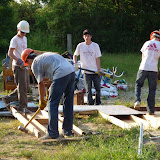
For most our crew, Tuesday and Wednesday invovled destruction. And they loved it.

"Demolition seems like the opposite of Back Bay," said Elliot. But as our group learned, it's also an important piece of helping out people here.

In this case, the group was tearing down a large shed that had been used as a house for a while. The owner, JW, had led some relatives live there after Katrina hit in 2005. It eventually became used as a drug house. Once officials got wind of this, they condemned the building and required JW to tear it down.

The thing is, JW has his own Katrina story. He's a man in his late 50s, the kids estimated. His wife is from Scotland. They got married just after Katrina and he was helping fix stuff that had been damaged by the storm. He was going through several small heart attacks that week and finally went to the hospital in Gulfport, where they diagnosed what was going on and eventually did bypass surgery. But he said he had been unconscious for 28 days and diminished circulation led to the amputation of a leg and several fingers. So he was in no condition to tear this structure down himself.

Back Bay came to this assistance and our folks were the assisters. Michael and Beth, the four guys -- Adam, Austin, Elliot and Phillip -- and Janine went out on Tuesday to begin the work. They stripped off the tin roof and began removing pieces of the structure. But the temp was setting new records for Biloxi in June, cracking 108 degrees where they were working on Tuesday. And as flimsy as this structure looked .. well, as Austin said, "Now that we're trying to tear it down, it seems a lot sturdier."

Michael tried to pull the whole thing down with a tractor, but that did not work on Tuesday. Eventually, the crew came in from the heat with a plan for Wednesday.

There was one casualty the first day. Phillip tried to break out what seemed to be fiberglass, but actually was real glass and got some cuts in the process. The second day, he really did get covered with fiberglass and he had the experience of a huge cockroach crawling up his leg and onto his bare stomach. But mostly, the casualties were tee-shirts drenched sweat.

So the gang got up before sunrise on Wednesday and left the trailer at 6:15 a.m. to do their work in the cooler part of the day. By 8:30, the structure was down. But getting it down took a combination of pulling with the tractor and guys lunging toward it like the front line of a football team. "All" that remained was the cleanup. That was done by 12:30 and the crew headed back for lunch, showers and a trip to the beach.

And then there's a footnote. At that point in the day when everyone was feeling pretty dragged out and discouraged, JW came out with something for us to read. It went like this:

TO: You
DATE: Today
FROM: God
SUBJECT: Yourself
REFERENCES: Life

This is God. Today I will be handling all of your problems. I do not need your help. So have a nice day. I love you.

P.S. And remember ...

If life happens to deliver a situation to you that you cannot handle, do
not attempt to resolve it yourself. Kindly put it in the SFGTD (something for God to do) box. All situations will be resolved, but in My time.

Once the matter is placed into the box, do not hold onto it by worrying about it. Instead, focus on all the wonderful things that are present in your life now.

If you find yourself stuck in traffic, don't despair. There are people in
this world for whom driving is an unheard of privilege.

Should you have a bad day at work, think of the man who has been out of work for years.

Should you despair over a relationship gone bad, think of the person who has never known what it's like to love and be loved in return

Should you grieve the passing of another weekend, think of the woman in dire straits, working twelve hours a day, seven days a week to feed her children

Should your car break down, leaving you miles away from assistance;, think of the paraplegic who would love the opportunity to take that walk.

Should you notice a new gray hair in the mirror, think of the cancer patient in chemo who wishes she had hair to examine.

Should you find yourself at a loss and pondering what is life all about, asking what is my purpose? Be thankful. There are those who didn't live long enough to get the opportunity.

Should you find yourself the victim of other people's bitterness, ignorance, smallness or insecurities, remember, things could be worse. You could be one of them!

Should you decide to send this to a friend, thank you. You may have touched their life in ways you will never know!

Now, have a nice day!
God

Drama in the front office

Kirsten spent part of Tuesday and Wednesday helping out in the reception area at Back Bay Mission. This is where people in need of help come. Sometimes the folks at the reception desk can direct them to services. Sometimes they can give them the things they need. Often, they connect them with one of the caseworkers at Back Bay.

Back Bay Mission is the only service agency in Biloxi (population about 50,000) that offers daily emergency assistance to people, so they get a steady stream of visitors.

Kirtsen said she loved this part of the trip because she was actually getting time with the people who live here. And on Tuesday, she was part of an extra measure of drama.

One of the gentlemen who came in was a frequent visitor to the mission. He was sweating a lot this day -- not unusual as the temp was climbing to 100. Kirsten talked with him a bit and eventually he went back to see a caseworker, where he told about his chest pain and shortness of breath. She determined that the man was having a heart attack and called 911.

Devastation remains along the coast

Tuesday night, we took a four-vehicle caravan with all 26 of us from both congregations along the Gulf Coast to get a little sense of the devastation that still exists after Katrina. It's an odd sense. There is a fully functional mall -- Dillards and all - right next to empty lots. Someplaces there are long stretches of grass growing over And then there are businesses and condos that are in full gear. There are almost no homes rebuilt along this stretch.

We went as far west as the University of Southern Mississippi Gulf Park. The dorms and administration there still stand empty, windows blown out, blinds dangling. You can peer inside and see things that have been thrown around the rooms. This is also the site of a sprawling Friendship Oak, that dates back to about 1487.

Do justice, love kindness, walk humbly with our God

Shari Prestemon's predecessor at Back Bay Mission came there with a well-defined task -- close the mission. The divisions of the civil rights movement in the 1950s and 1960s had split local churches. Back Bay's activism on behalf of the had created controversy in Biloxi. There were no longer any UCC congregations in Mississippi. The mission appeared doomed. But, Shari noted with a smile, her predecessor "failed." Back Bay Mission experienced a rebirth. And now it tries to live out the words of the prophet, Micah -- to do justice, love kindness and walk humbly with God.

Shari talked about the kindness part -- the food pantry, the outreach workers, the housing reconstruction. And she talked about the justice part -- asking why people faced oppressive conditions and then trying to change those conditions. "When you go home," she told our groups, "think about the justice issues in your back yards and then figure out what you can do about them."

Monday, June 22, 2009

A photo view of our week

Back Bay 2009

A day of painting

We started out this morning putting the final (we thought) coat of paint on the ceiling of a new house that is about to be turned over to a woman who has been displaced in the last four years since Katrina. "You know how excited you are when you move into a new house," said Bob, our crew leader from Back Bay. "Just imagine what it's like if you have had no home for the last four years."

But, of course, things did not go totally as planned. The paint was not quite dark enough and some slotches were showing through. So this afternoon, all five of our teens plus Michael and Janine went back to put on a second coat while Mary Kay, Beth and I, along with Allison from Cedar Hills UCC went to Winn Dixie to buy groceries for the next few days. When everyone gets back, we'll head to the Gulf shore and do a bit of swimming before dinner.

The temp, by the way, is pushing 100 and the humidity is, shall we say, noticeable.

Off the road – at last

The Memorial crew rolling into Biloxi at about 8:15 Sunday night. That was just about 11 hours after we left Parkway UCC in St. Louis, our home overnight on this journey. Other than being a long trip, we all had a good time, shifting the configurations of who rode where and who drove which car several times along the way.

A few of our group checked out early. Others stayed up to wait for our partners from Cedar Hills UCC in Portland, Ore. Part of their group was flying into New Orleans on a late flight, so they arrived in Biloxi at midnight and quietly (really) settled into the trailers with us.

Along the way, there were some highlights:

* Climbing outside on metal structures at the City Museum in St. Louis, "sweating half our body fluid out," according to Phillip Bessemer.

* Riding the tram to the top of the Arch, looking out over the Mississippi River on one side and downtown St. Louis on the other. It was an amazing view.

* Searching and searching for a place to have supper. We abandoned the idea of eating downtown because it was getting too late. We tried to find something near Webster University in Webster Grove, but got lost. Finally, we wound up at a Pizzaria Uno in Kirkwood, which turned out to be the perfect spot for a bunch of tired and very hungry travelers.

* Seeing a car on fire on the side of the road in central Mississippi.

* Endless rounds of DVDs, games on i-pods, music and converstation.

* Falling into our beds in the trailor at the end of the journey.

Thursday, June 18, 2009

Heading for Back Bay Mission


A group of us from Memorial United Church of Christ leaves Saturday morning for a week of work and exploration at Back Bay Mission in Biloxi, Mississippi. There are 10 of us -- five confirmation students (Adam and Phillip Bessemer, Elliot Schad, Kirsten Scheller-Suitor and Austin Young) and five adults (Janine Bessemer, Michael and Beth Magness, Mary Kay Scheller-Suitor and me). We will stop in St. Louis overnight on the way down and we hope to arrive at Back Bay early Sunday evening.

While we are there, we will be working with a youth group from Cedar Hills UCC in Portland, Ore. There are 12 young people and three adults in that group. We will be sharing trailers, food preparation and the work experience.

Then on Friday, we will go over to Good Shepherd UCC in Metairie, La., just outside of New Orleans. They have been deeply involved in the Katrina recovery work in New Orleans and will show us some of what is happening there and also show us a bit of New Orleans. Then we start the journey home on Saturday morning, June 27 and should be back in Madison at dinnertime on Sunday, June 28.

We hope to be posting updates here as the week goes on. Meanwhile, please hold us in your prayers.

(If you are interested in the November 2007 adult trip to Back Bay, you can read posts from that trip here.)

Saturday, April 25, 2009

Koran scholarship sparks fresh thinking

Nick Kristoff of the New York Times had a fascinating column this week about the explorations of Islamic scholars into the historical context of passages of the Koran. Those explorations are setting off debates within Islam analogous to the historical/critical scholarship done on the Hebrew Bible and the New Testament. You can click through to read the column -- "Islam, Virgins and Grapes."

Thursday, April 9, 2009

Trading violence for violins a tough task

There's a poster on the wall in my office that reflects the hopes of many people who get to know residents of the tension-filled lands of Israel and Palestine.

It shows a young Palestinian boy -- perhaps 6 or 7 years old -- his hands clutching broken pieces of rock ready to throw at the Israeli army. Looming above the boy is a handsome, poised young man playing a violin.

They are the same person, a man named Ramzi. The poster reflects the work done at the International Center in Bethlehem to create hope for Palestinian children in the midst of the violence of their world, to offer them creative outlets that can transform their lives.

It's the kind of image we in America like to see. It's the kind of image I treasure as someone who has a long-time commitment to nonviolent solutions to conflicts, who as a pastor often talks about the things Jesus said about loving enemies and forgiving one another and working for peace. Those teachings come into sharp focus during this week when Christians recall the execution of Jesus -- a time when he forgave his enemies -- and the message of Easter about life winning out over death.

So you can imagine my discomfort a few weeks ago as I watched Sol Kelley-Jones' powerful play, "The Birds That Are Your Hands: How to Start a Fire Under Siege." (It's playing weekends through April 19 at the Broom Street Theater.)

There is a scene where Ingrid, a woman representing a non-governmental organization from Sweden, meets Khalad, a Palestinian described as a "former" fighter.

"He was involved in the fighting?" Ingrid asks Hassan, who has arranged this meeting.

Hassan nods. "Lost all of his friends, most of his family." He shrugs. "This is the life."

Ingrid tells Khalad her charity wants to launch a humanitarian campaign for children. It would involve violins.

"Violins?" Khalad asks incredulously.

"Trading violence for violins," she says. "It has a nice ring. Where there is a Palestinian youth holding a stone to throw, well, we replace that stone, with a violin."

There was that poster on my wall.

Khalad is more than skeptical: "I see very few violins, many stony hills and, no open ears. That's what I see." He hears her talk about the beauty of music without any of the harsh words about the realities of living in an occupied land.

He compares the Palestinians to a bird in a cage. He hears her asking this: "That song about the cage, we don't like it so much, sing a song that is pretty to our ears and then we might shed a tear for you and maybe think about letting you out of the cage."

And then there is actual news about violins from Israel and Palestine. On March 25, a group of teen musicians from the Jenin refugee camp in the West Bank traveled into Israel to a suburb of Tel Aviv to present a concert for Jewish survivors of the Holocaust. There was a glow of hope around this extraordinary event.

Then a few days later, some of the political activists in the Jenin refugee camp condemned the concert and banned the Israeli Arab who led the orchestra from coming back into the camp. One of these leaders told the New York Times that the Palestinian teens had been brought into a political situation that "served enemy interests" and aimed to "destroy the Palestinian national spirit in the camp."

Once again, there were clouds over the hope that lingers in that poster on my wall. There are no easy answers here, just the tension that exists when people feel trapped like birds in a cage, when they hope to bend the bars and find freedom, when the sound of a song seems too weak in a cruel world.

For those who listen for the music, though, beauty is not enough. The music must also propel those who cling to hope to find ways to open the doors to that cage.

Published in The Capital Times, April 8, 2009

Tuesday, March 24, 2009

Crisis of faith in lands split by walls

When Sol Kelley-Jones was writing her powerful play about the people on the margins in the West Bank and on the U.S.-Mexican border, religious themes were only a subtext.

These, after all, were the stories of the people she encountered during a three-month stay in Palestine last spring and then a summer near Tucson working on the border. They were stories that often have a political edge, which is not surprising given how much politics affects the realities of life in these regions.

There are walls that separate people in both places, walls built by governments seeking to keep people out in the name of protecting those who are on the inside. The walls divide people in ways that the best of religious traditions would not accept, even though religious reasons may well be cited as justifications for the walls.

But for someone coming to this play – The Birds That Are Your Hands -- with a sensitivity for the religions dimensions at work in these two places, Kelley-Jones has managed to bring issues of faith into a sharp focus.

(You can read more about the play in my column in the Cap Times. The play is running at the Broom Street Theater through April 19.)

She said in an interview that in both Palestine and in the border region, she found that it was people working in faith-based aid groups that performed amazing tasks, often putting themselves at risk. What motivates her is progressive politics more than a specific religious commitment, yet she shows in the play her deep understanding of the religious tensions at work in these societies and in the lives of individuals.

There is the Jewish commitment to living an ethical life reflected in the ruminations of an old Jewish man who ponders what his country is doing to the Palestinians in their midst.
“Europe has always has a habit of hating Jews,” he tells the audience. “Now we can be colonizers. It is the Palestinians who pay the price for Europe’s anti-Semitism.”

He shakes his head in disbelief. “Jews – my people – are pondering the merits of concentration camps. I have live too long.”

Later, Jewish woman who is a rabbi talks about losing her faith in the Holy Land after witnessing what was happening there, then finding her faith restored when she began to bond with women in refugee camps – “my Muslim sisters.”

When the Palestinians face a crisis, they cry out the traditional Islamic prayer, “Allahu Akbar.” This is usually translated “God is great,” which often seems odd in a moment of tragedy. Kelley-Jones offered a more nuanced translation: “God is greater than this.”

But for a priest in the Arizona desert, the notion that God is great is mocked by the dead baby he finds. It is one of the heart-wrenching scenes in the play. The priest is kneeling, holding a rosary in his hands, reciting Jesus’ words from the Gospel of Matthew about how “I was hungry and you gave me to eat, I was thirsty and you gave me to drink.”

Then he looks up in anger at what people who call themselves Christians are doing to the immigrants who are dying in the desert. He mocks their words: “Who does this Jesus Christ think he is? He’s not with the program.”

As the priest’s despair over what he sees deepens, his posture shifts to the Muslim position for prayer, head touching the ground. He still holds the rosary, reminiscent of the Muslim prayer beads.

“I pray and I doubt,” he cries. “I pray for forgiveness for my doubting. God will care for you ... and the desert fills with bodies.”

Kelly-Jones does not offer any easy answers to the doubts of the priest or the rabbi or the Islamic characters in her play. She simply poses the questions for people to weight against their own faith traditions. It is provocative theater at its best.

Monday, March 9, 2009

Finding a place in a changing religious landscape

Two studies that have come out in the past few weeks raise some interesting questions for those of us who are part of the United Church of Christ.

The first study -- The 2009 edition of the Yearbook of American & Canadian Churches -- reported that the UCC was declining in membership faster than any other Protestant denomination. We were down 6.1 percent between 2006 and 2007, according to the data the UCC gave to the yearbook.

We were not alone in this decline. The two largest Christian denominations in the U.S. also reported declines -- 0.59 for Roman Catholics, 0.24 for Southern Baptists. They had been steadily growing in the past. The fastest growing denominations were the Jehovah's Witness (up 2.12 percent), the Mormons (up 1.63 percent), the Assemblies of God (up 0.96 percent).

The second study looks at the overall shifting of religious identification over a 20-year period. The headline - Christianity is shrinking as a proportion of the U.S. scene and people calling themselves non-religious are increasing. The study is called the American Religious Identification Survey and you can find it by clicking here.

Almost 20 years ago, in 1990, the survey reported, 86 percent of Americans described themselves as Christian. That percentage is now 76 percent. Likewise, in 1990, about 8 percent of Americans declared no religious affiliation. That is now up to 15 percent. And Wisconsin follows a similar pattern -- see this story from the Wisconsin State Journal.

So does this mean we should all crawl into bed and put our heads under the pillows? I don't think so.

These trends are useful to know about and to try to understand. They reflect the changing landscape in which we live. They provide material to think about as we look at we describe ourselves as followers of Jesus. But they really don't have much to do with what I believe as an individual.

My affiliation with Christianity grew out of my family experience as a child -- I was raised Roman Catholic -- but it has been shaped and refined by my experiences as an adult. I have made a conscious decision to be a Christian and I have chosen the UCC as the place that I think best enables me to deepen and live out my Christianity. Others may have chosen other denominational expressions or the non-denominational, evangelical Christianity that is has grown so much in this country over the past few decades.

I think I have something to learn from the evangelicals, from the disaffected, from Muslims and Jews and Wiccans and others. It may seem like it would be more fun to be part of a growing, thriving denomination. Within the UCC as an institution, there are all sorts of struggles about budgets and the staff and directions for the future. Those are institutionally important, but they are not at the core of Jesus' message.

That message is about loving God and loving others as we love ourselves. It's about working in this world to help it be the kind of place God created it to be. At Memorial UCC, that's what we are about. It's a vibrant community that sails against the tide of the trends showing up in these surveys.

That's not something to be smug about. That's all the more reason why need to nurture God's spirit in our midst and let it affect how we have an impact on the people and the world around us.

Friday, March 6, 2009

Finding hope in Mumbai

Ebo Patel, who heads the Interfaith Youth Core and is one of the great voices of our time for getting across the faith divides in our world, wrote this about how Mumbai avoided a religious battleground after the terrorist attacks there late last year.

Monday, February 2, 2009

60 Minutes on Israel/Palestine


Watch CBS Videos Online

Thursday, January 1, 2009

After the fighting in Gaza

Ebo Patel, director of the Interfaith Youth Corps and one of my favorite people these days, offers a view of the current catastrophe in Gaza that I have not seen elsewhere. He moves beyond the predictable rhetoric to try to find ways to hold American Jews and Moslems in conversation even in the midst of warfare.

You can read his column at the On Faith site of The Washington Post/Newsweek.

Sunday, December 28, 2008

The Green Bible

The Good Book goes green

Here's a column from the Cap Times about the new Green Bible.

Thursday, December 25, 2008

Christians in Bethlehem

One of my interests (and one of the partnerships for Memorial UCC) is the situation of Palestinian Christians in the West Bank, especially in Bethlehem. Here are three links from Christmas 2008 that provide insight into the current situation:

From the New York Times:
Palestinians Work to Jolt West Bank Back to Life

From CNN:
Christians in Bethlehem (includes interview with Mitri Raheb, pastor at Christmas Lutheran Church in Bethlehem) -

Christmas in Bethlehem