Friday, September 27, 2013

Obama reflects on death and resurrection

Joshua DuBois started working for Barack Obama in 2004 when Obama was running for the U.S. Senate. He guided Obama’s faith outreach efforts during his presidential campaign and then served as director of the White House office of Faith Based and Neighborhood Partnerships from 2009 until this past February. Later this month, he has a book coming out called ThePresident’s Devotional: Daily Readings that Inspired President Obama. The book will include not just the readings, but some of DuBois’ reflections on dealing with the spiritual dimensions of the crisis that roll through the White House.

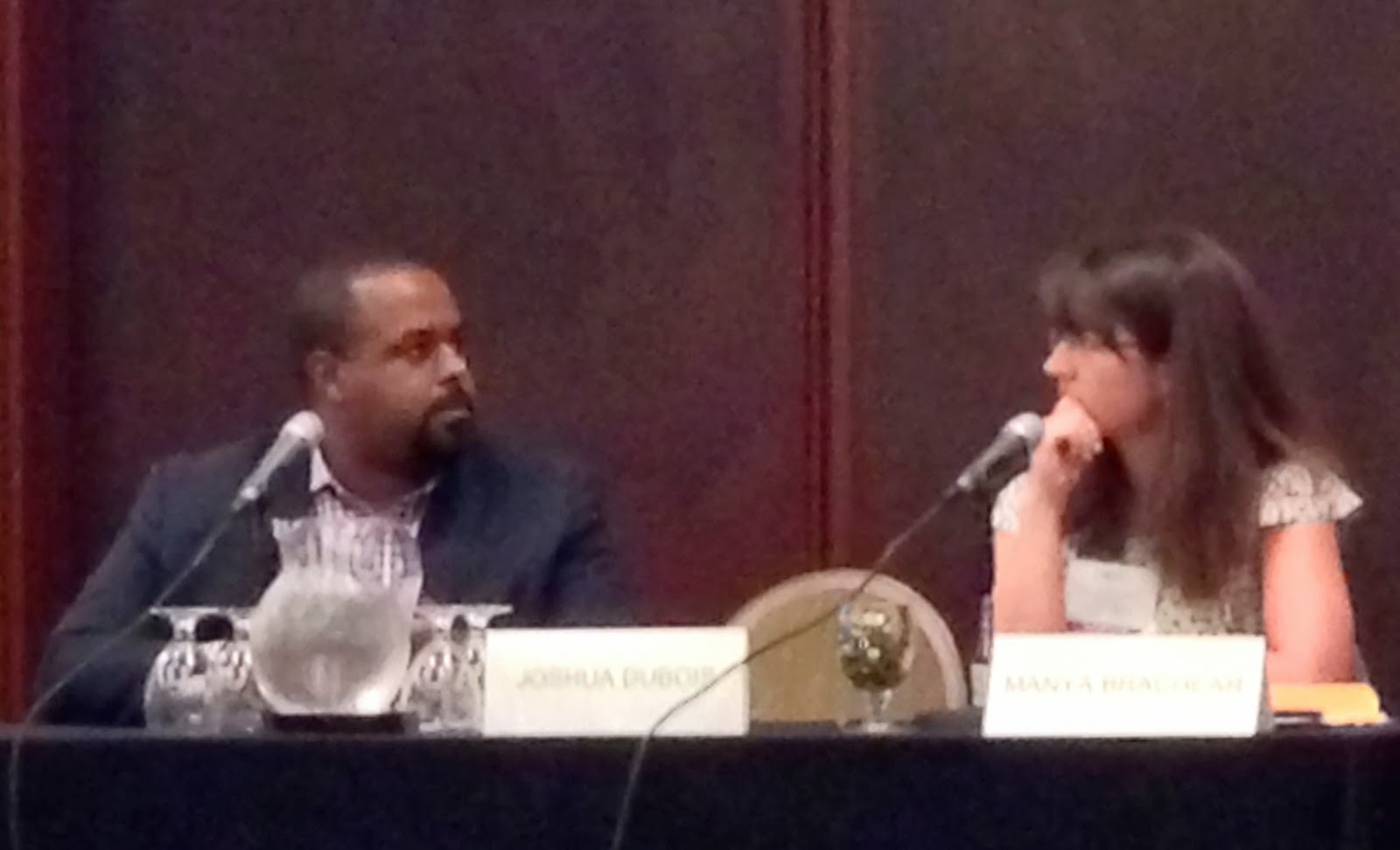
Joshua DuBois talks with
Manya Brachear Pashman
of the Chicago Tribune.
DuBois talked with journalists at the annual conference of the Religion Newswriters Association today in Austin, Texas. There was some tension in the room, because journalists who cover religion found the Obama White House a very difficult place to get access to, but DuBois still praised them for their focus on the issues involving people’s search for meaning.

One fascinating tidbit. He talked about how Obama started an Easter Prayer Breakfast several years ago, inviting a wide range of Christian pastors to join him and then each year, revealing a little bit more about his own understanding of “what the death and resurrection of Jesus meant to him.” DuBois lamented that these did not get enough attention but said they offered a depth of insight into the spiritual side of Obama.

So for those who are interested, here are links to the speeches from the past several years:

April 6, 2010


1st Amendment for people or institutions?

One of the clearest delineations of the terms of the debate over religious liberty came in an unexpected place on Thursday.

Speakers and panelists from many viewpoints had offered their perspectives in a series of presentations in a conference room at the Texas State Capitol as attendees at the Religion Newswriters Association pre-conference probed contentious issues ranging from the Obama administration mandate on including contraceptive care in health insurance to the rights of high school cheerleaders in a small Texas town to put Bible verses on the banner that football players would crash through on their way into the Friday night game.

But it was at an unrelated session on the growing concern about sexual abuse by religious leaders beyond the well-documented Catholic priest scandal that William Bowen framed the issue in a way that I think covered so many of the issues discussed on Thursday.

Bowen, national director of Silentlambs, an organization dedicated to helping the survivors of abuse, was talking about the resistance of the Jehovah’s Witnesses hierarchy to efforts to hold them to account for child molestation by leaders in their communities. He said they always came into court waving the flag of the First Amendment, saying that the government could not touch them.

“The First Amendment was written to protect the rights of the people,” Bowen asserted, “not to protect religious institutions that hurt people.”

He was framing it in particular to argue that religious institutions ought not be shielded from religious accountability for lawbreakers in their ranks. But the broader issue, it seems to me, is whether the First Amendment is to protect people or institutions.

At an earlier panel, Jeff Mateer, general counsel for the Liberty Institute that aggressively pushes back at efforts to limit religious expression, cited the example of a student asked to write an essay about a hero who then picked God as her hero. She was told that was unacceptable. Matt Dillahunty, host of the Atheist Experience program and not normally an ally of Mateer, said, sure, she should be able to write that essay. It is her viewpoint.

The First Amendment was protecting both belief and speech, they agreed. 

Here's a good summary of that panel from Brian Pellot of the Religion News Service.

Laurie Goodstein of The NY Times
asks Steve Green a question
at the RNA meeitng.
The biggest battle over religious liberty at the moment is over the contraception mandate, of course. It pits groups like the Roman Catholic bishops and Hobby Lobby owner Steve Green against the Obama administration’s insistence that employers offer contraception within their health insurance coverage.

The Hobby Lobby case may well be the first one to reach the U.S. Supreme Court. The Hobby Lobby position that including contraceptive coverage in its health plan violated the company’s Christian-based opposition to such coverage was upheld in a lower-court ruling.

Green said that he could not countenance the notion of his company being required to be, in his words, “an abortion provider.” That, of course, uses the disputed view that contraceptives don’t merely prevent conception but end an incipient life.

The Catholic bishops, interestingly, may actually have some more room to maneuver on this. Even though the church’s opposition to contraception is deeply rooted and well-known, Fr. Thomas Nairn, senior director of ethics for the Catholic Health Association, and Prof. Andrew Getz of St. Mary’s University in San Antonio, talked about renewed attention to an old Catholic moral principal dealing with cooperation with evil.

In essence, the question is how close one is to the evil being done. The greater the distance, the lesser the moral culpability. In the contraception case, they suggested, there is some ability for Catholic institutions to work their way through this with the kind of exemptions the Obama administration has offered to require the insurance companies themselves to absorb the costs of contraceptive care.

Those exemptions are not available to non-church related employers, though. Cue the Hobby Lobby case, that will include the question of whether of corporation is a person.

Which takes us back to that framing of the religious liberty question. Whose freedom is being protected? Under what circumstances? And how to resolve those clashes.

The recurring answer throughout the day. These issues never get resolved. They are part of the tension of a democratic society.

The bright sport was the gracious spirit of everyone throughout the day toward people who were diametrically opposed to their viewpoint. Score one for civility.


Tuesday, June 4, 2013

Lessons in life and dying from a friend

My friend Mike died last week.

We were the same age. We grew up together in Marinette in northeast Wisconsin. Worked our way through Boy Scouts together. Played at each other’s houses. Studied in the same classrooms. And then, over time, we drifted apart. Until this past year. That’s when I learned that Mike was dying of cancer.

In less than 12 months, we re-established a friendship and Mike and his wife, Nancy, taught me amazing lessons about living with the prospect of dying.

In our initial contacts, Nancy wrote of Mike: “He is doing well with his treatments.  I am amazed, each day, how well he handles this journey we are on.  Never once have we asked ‘why us?’  We feel so blessed that we have each day to love each other and enjoy our retirement one day at a time.  Not everyone is so lucky to have a long goodbye with the one they love.“

Just a note about the actual diagnosis. Mike had stage IV small cell lung cancer that had metastasized to his bones and a bit to his liver. The initial diagnosis came on May 2, 2012, with the expectation that he might live for about a year. He beat that by about a month.

We lived 300 miles apart, but we managed to meet three times face to face over the past year. We communicated in between by email. And we held each other in prayer all along the way. 

An email Mike sent out to a network of friends in late July of 2012 offered clues to his attitude: “The chemo is working to slow the cancer down… I am losing a lot hair, but I have discovered the joy of hats! … I am happy and fulfilled.  This is wonderful journey, and the biggest adventure of my life.  And I am getting plenty of time to be ready for the big event.” 

He understood that Nancy and their kids and grandkids were not quite as thrilled with this big adventure, but he was not about to let a simple thing like dying cramp his style.

Mike wrote me in early December to say that the growth of the cancer had slowed enough so that the resumption of chemo had been postponed.  “Spiritually, new wonders everyday,” he added.  That’s what really seemed to matter to him. He was experiencing a sense of God in wholly – and holy – new ways.

Dying also shifted Mike’s view of the world a bit. Our conversations often touched on religion and politics. I though Mike might enjoy one of my favorite magazines, Sojourners, so I got him a subscription. He liked it, noting that “Liberal values without spiritual values are bleak.  I hate judgmental liberalism, just as I hate judgmental conservatism.  Sojourners looks at liberal values with a strong Christian feeling of hope and love.   It looks at what we can do to build, not to defend or destroy.”

Later, he would strive for greater peace within, writing that “I avoid all things that thrive on negative energy, like the news, gossip, cruelty, conflict, or bad humor (the cruel, the meanly sarcastic, and the sacrilegious).  I can look out our bedroom window and see our snow covered hill, trees, sunrise and moonrise.”

Mike sent a health update on Groundhog Day – Feb. 2. Continued growth of the cancer, more pain and fatigue, chemo about to resume. But he also sent a second message that day to those who were more attentive to his spiritual journey: “Spiritually, I feel healthier than ever. My prayer and meditation life is rich… Since I can't volunteer outside the home anymore, I was able to join our parish prayer ministry, since I now have plenty of time to pray. I really enjoy praying for all of you in Arizona, Michigan, Wisconsin, Illinois, etc. who are praying for me… God is good.  God is great.  Hope is eternal.”

If hope was eternal, so was Mike’s sense of humor about a situation that would lead many of us to despair. By mid-February, Mike could really feel his body slowing down: “My material world is shrinking, and so is my body. Just like the wicked witch from the Wizard of Oz, ‘I'm melting! I'm melting!’ We had to get a handicapped parking permit for our car. I walk like a crooked old man, with a crooked old stick, but let's face it, that's what I am…”

Within the next few days, Mike shifted from the chemo regime to palliative care with Hospice. He was thrilled: “Now I can look forward to a happy, peaceful death surrounded by loving family, friends, and a fully qualified, fully experienced and fully compassionate medical team. Nancy is a little weepy, but happy/sad weepy.  I feel like the Packers just won the Super Bowl.”

And then a pitch for prayer: “So anyway, keep praying for a happy, peaceful death for me.   If you are praying for me, let me know, as I add you to my prayer book and I will pray for you too everyday and I hope to pray for you when I get to heaven.... God willing.  Bless you all with love, peace, and joy,”

In late April, Mike sent out a detailed medical update, laced with his own brand of humor.  “I just wanted to send you the latest chapter in the ongoing saga of my final earthly journey, focusing on the old jalopy called my body that is on its last miles… I am so grateful for this last year to get to contemplate my life, reach out and discover old friends, strengthen my ties to my family, reach out to others who are suffering from a loss, and even reconcile some emotions stemming from the past.  Fruitful!”

He recognized God in the care that others showed for him, especially that of his beloved Nancy. “I have never felt so loved by God and so close to Him.” He signed off, “May we all live forever in love, peace and joy.”

His final email went out on May 21, just nine days before his death. “I have shared with many of you how well I am doing spiritually,” he wrote. “I feel so close to God, I feel like I can almost touch his face and feel his breath.”
  
Mike died early in the afternoon of May 30 – the traditional date for Memorial Day, the day his father’s plane was shot down during World War II. Nancy was at his side, the kids were in the house. Now he is with God.

Saturday, October 6, 2012

Notebook jottings - Part 2

The Religion Newswriters Association conference continues in Bethesda, Md. Here are a few more notes from Friday and Saturday at the event.

At a presentation called "50 Shades of Evangelicalism," a group of younger evangelicals talked about the growing diversity among this substantial slice of Christians in America. The diversity does not all move in one direction.

Robert Jones of the Public Religion Research Institute, for instance, noted that even though younger evangelicals trend more liberal on social issues, their support of Mitt Romney now is higher than that for John McCain four years ago. Patton Dodd, executive editor of Bondfire Books (e-books), said younger evangelicals often struggle with how to define themselves, since they don't fit into conventional stereotypes. And Sarah Pulliam Bailey, the new managing editor of Odyssey Networks after serving as the online editor at Christianity Today, said that when she was a student at Wheaton College, just outside Chicago, she found that "a lot of people know where they are from but they don't know what they are right now."

Brad Russell of FaithVillage.com, a new social network with appeal in the evangelical world, wondered if "evangelical is still a valid term." And panelists talked about the debate among the evangelical leaders about who could be called an evangelical and who could not. Is author Brian McLaren still an evangelical if he supports gay marriage? Dodd said the issue is do you identify yourself or do others define you.

Russell said a significant change in attitudes on social issues like gay marriage reflected a greater tolerance of a pluralistic society: "What's not right for me does not have to be a matter of law for everyone else... Younger evangelicals have grown up thinking their stance in the public square has been defined for them." They no longer accept that.
++++++
Perhaps the oddest session of the conference was one where representatives of the Obama and Romney campaigns faith outreach operations were invited to "tell war stories from the front lines."
First, the two from the Obama campaign - Broderick Johnson and Michael Wear - refused to let C-Span video the session. Then all three of them said in many different ways that faith really did not matter that much in the election, even though that was their area of focus. As Bob Smietana of the Nashville Tennessean tweeted:  "Faith advisors on panel want to talk about works, not faith."
++++++
Stephen Prothero discussed his new book, The American Bible: How Our Words United, Divide and Define a Nation. It's a collection of 27 texts with a varieties of commentaries on each that he defined as "the texts that we value and fight about." He said that the U.S. is "held together not by a common creed but by a shared argument." And that plays out in the pages of this book.

Prothero acknowledged that sometimes the argument can get out of control. He suggested that the great thinkers of the past modeled how people could engage in public conversation and he cited the Jewish tradition of two kinds of arguments - one on behalf of the self, the other on behalf of heaven. An argument on behalf of heaven recognizes that truth resides there, not in any one of us, so as we listen and as we talk, we can come closer to the truth.


A Mormon trio on the Mormon moment

Jana Reiss converted to the Church of Latter Day Saints as an adult, has written a lot about it and would generally be considered fairly knowledgeable about the faith.

But she said she was brought up short after addressing a group of Protestants who asked her about the "white horse prophecy." This is something attributed to Mormon founder Joseph Smith about his followers who would come from the Rocky Mountains on a white horse to save the U.S. Constitution as it hung by a thread. Whether Smith ever said it is in doubt, but it has gone into circulation around the prospect of Mitt Romney being the first Mormon president of the U.S.

That's one example from a panel of Mormons today talking about how their faith has gotten a lot more attention in the past few years, whether because of the Romney campaign or the hit Broadway musical, The Book of Mormon.

There has been a lot of interest in what is unusual or exotic about the faith, said Terryl Givens, a Mormon scholar at the University of Virginia. "So the Mormon sense of self has been challenged," he told folks attending the Religion Newswriters Association annual conference in Bethesda, Md.

Darius Gray, an author and film producer, said that in the past when controversy around his faith arose, the leaders would run for cover or issue inflammatory responses. Now they are telling their story in very human terms, which he appreciates.

Yet Mormons still deal with accusations that they are not truly Christians, even though the name of their faith is the Church of Jesus Christ of Latter-Day Saints.

Givens said Mormons are "bewildered" by the claim that they are not Christians. He said the evangelical Christians have a theology derived from Christians of centuries past and are not willing to consider other understandings of how one follows Jesus.

That prompted Reiss to say that for her, it's been "a very painful year to be a Mormon."

She told of watching the Republican convention on the night a series of Mormon speakers talked about the way Mitt Romney had lived out his faith, using easily accessible language instead of insider talk. "I had a sense of Mormons being welcomed in the public square," she said.

The next day, she received word from the Academy of Christian Editors that her invitation for membership was being rescinded because she was a Mormon - a notification that hurt her deeply.

Gray, who is an African American, noted that he is about to celebrate his 48th year as a Latter-Day Saint and talked about the change in attitudes in the church that once barred blacks from the priesthood. He helped tell those stories in a movie called Nobody Knows: The Untold Stories of Black Mormons.

Gray said that overall, he was pleased with the greater understanding of the Mormon faith and of Mormons that he senses is occurring. "The Latter-Day Saints aren't as weird as some may have thought," he said with a chuckle.

But it was Givens, who has a new book coming out on Monday on Mormon beliefs, got into the heart of Mormon theology by outlining what he described as the five core beliefs:

  • Humans have a heavenly father whose heart beats in sympathy with human hearts,
  • Humans pre-existed as spirit beings, 
  • Mortality is not a catastrophic fall but an ascent to greater godliness,
  • God has capacity and desire to save entire human family
  • Heaven will see the preservation of relationships most valued on earth (a reference to eternal marriage).


Schools, faith and freedom

So who is protecting free expression of religion in public schools these days?

Here's one surprising answer - the ACLU.

Daniel Mach, director of the ACLU Program on Freedom of Religion and Belief, told journalists at the Religion Newswriters Association annual conference on Friday about efforts in defense of students:

  • Fighting a rosary ban in one school (it was banned because some gangs were using it as a symbol)
  • Defending a Native American students' right to have long hair as a religious expression
  • Arguing that a student had a right to sing "Awesome God" as an entry in a student talent show
  • Making sure students were allowed to use a Bible verse as their personal quote on a yearbook page

Of course, the ACLU also jumps in when schools try to impose a particular religious viewpoint on students.

Mach talked about a public school in Chesterfield County, South Carolina, that set aside a day devoted to "converting as many people to Christ as possible" in all-school assemblies. Students who chose not to attend the assemblies were given the "option" of serving time in detention.

Charles C. Haynes, one of the nation's top scholars on the First Amendment who directs the Religious Freedom Education Project at the Newseum in Washington, D.C., argued that the general consensus on how to handle religious expression in public schools has grown fairly strong, while agreeing with Mach's observation that while "the rules are clear, there are rampant and repeated abuses."

Haynes said that the 1962 U.S. Supreme Court decision banning organized prayer in public schools - a decision long vilified by conservatives actually "opened the door to more discussion of religion in schools than ever before." The guidelines that have emerged over the half-century since then have created space for thoughtful examination of various religious traditions and left open room for individual student expressions of religious beliefs.

But those are also areas that are still contested on the ground, as Mach suggested. Haynes said one of the on-going struggles is over when a student may give a religious expression to what is essentially a captive audience, as compared to a prayer group gathered for an extra-curricular activity. Some groups try to rig the rules to make sure their viewpoint - and only their viewpoint - is the one that is favored.

A second area is over how courses approach the Bible. "There are a lot of stealth laws to encourage Bible courses," Haynes said. While there is nothing wrong with treating the Bible as an academic subject, he contended, what some districts do is use a Bible course as a form of religious instruction - and that violates the notion that public schools should not favor a particular religious belief.

Looking more broadly at the First Amendment protections for freedom of religion, Haynes quoted James Madison's observation that the more diverse we are as a people, the more protection of freedom of religion for everyone there will be. When one faith is overwhelmingly dominant, it is easier to steamroll those who don't share that faith.

Anthony Picarello, general counsel for the American Catholic bishops, reminded the audience that "everyone is a minority somewhere." The ACLU's Mach echoed that, saying, "Virtually all religious groups have been in the minority at one time or in one place."

Arguments over religious expression are nothing new in U.S. history. Haynes noted that Alexander Hamilton tried to form what we would now call an early version of the Christian Coalition while Madison and Jefferson argued for a free marketplace of religious ideas.

Haynes praised the U.S. for have "the boldest free expression of religion of any country" yet cautioned that "the vitality of religious freedom depends on the minds and hearts of the American people."

Thursday, October 4, 2012

Notebook jottings as journalists gather

The Religion Newswriters Association is gathering for its annual conference this week in Bethesda, Maryland. Here are a few vignettes along the way.

Joanna Brooks is a professor at San Diego State University and the author of “The Book of Mormon Girl: Stories from an American Faith.”  She said that in the run-up to the presidential debate on Wednesday night, some Mormons were fasting so that Mitt Romney would have a successful debate. "We're all going to fast to make sure our guy kills in the debate ... and he does!"

Brooks also noted that there is a "feminization of heresy in many traditions ... women who do not speak in orthodoxy are excluded."
+++++
In a discussion over what's fair game about religion for reporters to ask candidates, David Campbell, a ;olitical scientist at the University of Notre Dame and co-author with Robert Putnam of American Grace: How Religion Divides and Unites Us, offered this proposition: "Religion is relevant only to the extend it has a plausible connection to what that person would do in office." Bill Keller, the former executive editor of The New York Times, argued in a column last year and in person on Thursday that journalists should be "less shy about probing the religious beliefs of candidates." He said a candidate's religious beliefs can be a window in how he or she views science, gay rights and a host of other issues. 
+++++
David Beckmann, head of Bread for the World, exuded great enthusiasm as he talked about the progress in the battle against global poverty. "The world has cut in half the number of people in extreme poverty in the last 30 years," he said. Using Biblical imagery, he called this "the Biblical exodus of our time."
+++++
Thomas Reese, S.J. is a senior fellow at the Woodstock Theological Center at Georgetown University. He said that too often we cite violation of church state boundaries just because we disagree with someone. "If I disagree with you, then you are violating the separation of church and state," he said. That ignores that "politics is a hard and ethical endeavor."

He observed that while the Catholic bishops still hold to the "consistent ethic of life" approach of the past generation, their emphasis has shifted away from economic issues to things like contraception, abortion and gay marriage. He noted they will grant "prudential judgment" to people on issues around things like poverty, but say that on things like abortion or gay marriage, there can be no dissent. That, Reese said, is "a fundamental misunderstanding of prudence."

Reese also posed this question: "Did the Nuns on the Bus have more impact than (the bishops' religious liberty campaign known as) the Fortnight of Freedom?"
+++++
The brand new dean of the National Cathedral, The Very Rev. Gary Hall (brand new as of Monday), talked about his vision for the future work of the Cathedral as we gathered in a conference room seven stories up in this magnificent building. One element is to use the Cathedral's "convening power" to focus on the intersections of faith and public life. Another is to build on a tradition of interfaith dialogue to be a convening presence for interfaith ministry. Another is to be even more a part of "healing the wounds and addressing the needs of the people of Washington D.C. And, of course, there is the matter of raising $20 million in the next five years to repair the damage done from the August 2011 earthquake.

+++++
Sally Quinn, who started the "On Faith" section of the Washington Post web site six years ago, welcome journalists covering religion to Washington - "a spiritual hardship post." She told of starting "On Faith" because she was concerned about the lack of coverage of religion everywhere, including the Post. She could not persuade editors to do much, but Don Graham, the publisher, told her to start a religion web site on the Post's site. "I didn't know anything about religion and I didn't know anyting about the web," she said. So she gathered smart people from both fields together and now On Faith is a powerhouse in the field of journalism about religion. When her friends asked her if having a religion site would not stir up controversy, she told them in Washington, "people's egos are much more sensitive than their souls."


Religious liberty? How about for mosques?


One of the subtexts of the political season this year has been the debate over religious liberty. Has the Obama administration’s rules on making contraceptives available for free to employees violated the rights of Catholic institutions that oppose artificial birth control?

The American Catholic bishops have launched what they call a Fortnight of Freedom to defend their right to deny contraceptive coverage in insurance plans for their employees. They have gone to court to challenge the government’s ruling.

But a recurring theme today in panels at a session for journalists from across the nation who cover is religion is that this misses the real threat to religious liberty in this country.

Melissa Rogers, director of Wake Forest University Divinity School 's Center for Religion and Public Affairs, said that the spate of attacks on mosques “is a critical religious freedom issue” as she talked with Religion Newswriters Assoication participants in a conference on religion and politics at the Wesley Theological Seminary in Washington , D.C.

“We’re not talking about religious freedom if we’re not talking about that,” she said.

Since early August, there have been nine acts of vandalism or arson at mosques in the U.S, including one last weekend in Toledo, Ohio.

There was also the shooting of worshipers gathering at a Sikh temple in Oak Creek near Milwaukee in  early August.

In a separate session later in the day, Sally Steenland of the Center for Amerian Progress said that while there are many components to religious liberty, “the most basic one is the freedom to worship.”

Attacks on mosques, attacks on worshippers on a Sunday morning, are far more of a threat to religious liberty than the ongoing legal battles defining the boundaries of the relationship of church and state.

Jerome Copulsky, who teaches history at American University, noted that too often, the idea of religious freedom is being used to "shore up the privileges of the dominant religious traditions" in this country instead of to protect those traditions that are most vulnerable.

Thursday, July 26, 2012

Meditations from a Mountain

Mt. Rainier, July 14, 2012


I will lift up my eyes to the hills. From where will my help come? – Psalm 121                                            


At first sight, Creator God, the mountain seems so powerful, so majestic, so unchanging.

It seems to be such a good image of you, the one whose creative power released the energies of the universe and sustains them across the eons.

As we draw closer, the power of the mountain increases. So does a sense of foreboding. How does one approach such a magnificent and sacred place?

With awe, with respect, with boldness, much as we might approach you.

We watch the early morning light begin to dapple the summit. We see it spread its brilliance across the vast sweep of the highest reaches of this place.  We watch the light reflected off the whiteness of the snow-covered slopes. We sense the illumination you bring into our world, into our lives.

But this mountain is not unchanging. Volcanoes of the past have changed its shape. Glaciers crawl down its sides, grinding away its surface, spreading into the valleys they have carved out of landscape. Are you, too, a power that remains in motion, reforming and reshaping your existence in our lives?

And the forces that bring change to the mountain bring threats to our lives. The glaciers open and swallow up hikers. Some day, the bubbling lava below the surface will break through again, reshaping the landscape once more, covering cities and people in the process.

We recognize the terror masked in the beauty and we hope that your creative force will carry us toward renewed life rather than to imminent destruction.

Along the slopes, tiny flowers in blues and yellows and reds and purples stand out among the lush green carpet or accent the brownish gray of the rock. They are delicate, vulnerable, yet bring so much beauty to what is such a harsh landscape. The mountain nurtures them, just as you nurture us as we live as vulnerable people made in your image and sustained by your love.

And then the clouds begin to swirl around the peak. The clarity of earlier times is gone. The mountain is obscured. We know it is there, we can still feel its presence, but now it is an unseen presence. Sometimes when we look for you, O God, we cannot see you. The clouds of life, the mists of doubt make you hard to find. Yet we trust that you are always there.

It’s dusk now,

The mountain still towers over us. The deepening shades of the sky begin to absorb this powerful, majestic, site.

There is a stillness in the air. In the stillness, beneath the mountain, we sense your presence in our lives.


Be with us, Creator God.
Help us find you in the glories of your world,
in the moments of terror in our lives,
in our vulnerable times and when we feel lost in a fog.

Be with us as we climb the paths before us,
trusting that your love and your care will be with us wherever we may go.
When we lift up our eyes to the mountain,
let us find you there, may your help be always with us.
Amen.


Saturday, March 10, 2012

The Spirit of Justice

I had an opportunity to offer the invocation at the beginning of a vigil at the Wisconsin State Capitol on March 9, 2012, marking the first anniversary of the passage of the bill that severely limited the collective bargaining rights of public employees. The vigil was organized by We Are Wisconsin. About 250 people gathered on the Capitol steps at the State Street entrance, many of them holding battery-run candles glowing in the darkness. Here's a link to a video.


How many were here last February as this Wisconsin uprising began?

How many were here last March as the crowds grew and the demands for justice grew louder?

When you were here, could you feel a kind of spirit moving through these crowds, a spirit that took us out of our own little worlds and connected us to something much bigger?

Could you feel a spirit of community?
Could you feel a spirit of justice?

For those of us in faith traditions, there was a bit of God in those spirits.

Now let me ask you something else?

Remember the many groups that have come together here seeking justice?

The firefighters and the farmers?
The teachers and the prison guards?
The police officers and the students?
The retirees and the nurses?

The list goes on and on.

In the midst of all those groups at each of the rallies last year were people from many of the different faith traditions that make up the spiritual quilt of Wisconsin.

Many of us carried this sign, a sign that says “All religions believe in justice.”

It’s a theme that runs through the Hebrew scriptures and it's a theme that runs through the words of Jesus. It’s part of a core Muslim pillar of sharing wealth. It’s within the Buddhist concept of compassion.

For those like me who are in the Christian tradition, this is a season we call Lent, 40 days devoted to thinking about how we can better live out what we believe before we celebrate the hope that comes with Easter. For some, it is a time of fasting, of giving things up.

But it’s also a time to remember the words of the Hebrew prophet Isaiah – the very prophet Jesus quoted when he defined his mission as bringing good news to the poor, release to the captives, sight to the blind and freedom to the oppressed.

Isaiah is channeling God in this passage:

 "This is the kind of fast day I'm after:
   to break the chains of injustice,
   to get rid of exploitation in the workplace,
   to free the oppressed, to cancel debts.

"If you get rid of unfair practices,
  if you quit blaming victims,
  if you quit gossiping about other people's sins,
  if you are generous with the hungry
  and if start giving yourselves to the down-and-out,
then your lives will begin to glow in the darkness.

“You'll be known as those who can fix anything, restore old ruins, rebuild and renovate, make the community livable again.”

We’ve been through a very tough 12 months in Wisconsin,
a year when the rights of workers have been diminished,
the rights of voters have been restricted,
the needs of the poor have been trampled.

We’ve been through a year of blaming victims
and a lack of generosity of spirit or of money.
We have seen the fabric of our Wisconsin community frayed around the edges.

So if you are so inclined, would you join your voices with me in this prayer? Could you answer each line with “Let the light of justice glow in the darkness.”

Divine Spirit, we call you by many names, but we join together in seeking your presence among us this evening.
“Let the light of justice glow in the darkness.”

We gather here holding in our hearts those who have suffered so much during the past year, those whose incomes were diminished, whose jobs were eliminated, whose future is more uncertain.
“Let the light of justice glow in the darkness.”

We gather here holding in our hearts those who have felt the sting of animosity from elected leaders, from amplified voices, from fellow citizens.
“Let the light of justice glow in the darkness.”

We gather here holding in our hearts the pain of friendships shattered, families divided, close bonds broken in the midst of the turmoil of this past year.
“Let the light of justice glow in the darkness.”

And we gather here holding in our hearts hope for a better future, a place where everyone’s labor will be honored and rewarded, where everyone’s place as a citizen will be respected and protected, where no one will lack a place to sleep or a meal to eat or the medical care they need.
“Let the light of justice glow in the darkness.”

Give us the wisdom and the courage to restore what has been ruined,
to rebuild and to renovate our democracy,
to make the community livable again.
“Let the light of justice glow in the darkness.”

Say it again.
“Let the light of justice glow in the darkness.”

Say it again.
“Let the light of justice glow in the darkness.”

May it be so.

NCEW makes me a Life Member


The National Conference of Editorial Writers, a group I have been part of since 1984 and that I served as president in 2002, this year honored me with a Life Membership. It practical terms, it means I don't have to pay fees for future conventions. But what is more important is the recognition from my friends and colleagues in the opinion-writing world of journalism.

This text is posted on the NCEW web site, but it is in the members-only section, so I am posting it here. Below the text is my response. Thanks to all who made this possible.

From the NCEW Convention, Sept. 17, 2011, in Indianapolis, IN.

This year’s honoree as an NCEW Life Member is gentle man, but also a man with firm, well-grounded convictions he never shies from defending. During his fourteen years as an opinion writer, he wrote with style and argued with substance. His soft spoken approach belies the intensity of his convictions.


He well understands that a key role for opinion writers is to help those he serves to understand and deal with the complexities life presents. His principled approach to his chosen profession made him a valuable guide and his graceful style fortified with persuasive substance made him an effective and respected writer and editor.


His understanding of and loyalty to his home state and its capital was at the heart of his long and productive career.


But his leadership was not confined by the Wisconsin state borders. He brought his skills to the NCEW as a committee member, board member, Foundation trustee and, ultimately, as president. During his service on the NCEW board and during the years he held the ladder offices leading to his presidency, he was always the voice of reason, steadiness and creativity. He cares deeply about our profession and about how NCEW can make its members better at their craft.


His leadership leading up to and during NCEW’s management changes set him apart. He was sensitive to the needs of all involved and yet deeply committed to the need for NCEW to move to a new level of operation. His skill and grace were nowhere more apparent than during that difficult transition.


When he decided to shift his devotion to "speak truth to power" in a different venue as a minister of his faith, a newspaper colleague wrote that he was "one of those men who actually practice what they preach." His NCEW colleagues know the truth of that.


Therefore to Phil Haslanger, with appreciation and deep and great affection, NCEW renders its most significant honor, Life Membership, for all that he has done and all that he will continue to do.


I could not be at the convention to receive the award, so Neil Heinen of WISC-TV in Madison arranged for me to do a video response. Here's what I said:


Why, oh why, you might ask, when I should be with you in Indianapolis to be totally surprised at this wonderful award am I instead sitting in Neil Heinen’s TV studio talking to you in disembodied form?


While you are letting that dinner settle in and awaiting what I know will be a delightful presentation by Joel Pett, I am on an airplane somewhere between North Carolina and Wisconsin. I’m now on the board for the Religion News Service, run by the Religion Newswriters Association, and that meeting is still going on. I also need to be back for that church thing I do on Sunday mornings where we have some special things happening tomorrow.


I’m really sorry not to be with you tonight, especially when I get this incredible honor from my friends and colleagues at NCEW. I know how significant this award is – not because I get a price break on future conventions (that’s nice, of course) but because it represents a recognition by some of the most important people in my professional life of my connection to this amazing organization.


Since I joined NCEW in 1984, it has been the primary journalism organization that has nourished me professionally. It was an NCEW seminar in San Antonio in 1995 that introduced me to the possibilities of using the Internet as a new way of extending the opinion role of journalism. The insights I gained there led me to be part of the team that moved my own paper in Madison, The Capital Times, into what we then called cyberspace. That experience continues to enrich my work in connecting people, whether through journalism or the church world I now inhabit.


It was through NCEW that I had the chance to be part of a group having lunch with Ronald Reagan at the White House, with Kofi Annan at the United Nations, to go deep inside Cheyenne Mountain where the nation’s air defense system was headquartered and to share a seat on the King Kong ride at Universal Studios with a couple of Pulitzer Prize winners. There is no end to NCEW convention stories, of course, but you can hear some of those from the folks you are sitting with tonight.


Mostly, I just want to say thanks for this honor, thanks for all NCEW has done for me professionally and personally over the years, for the many friendships that have grown out of this organization. I’m glad that over the years, I could play a role in helping lead it through some times of transition. My best wishes to all of you as you navigate the choppy waters of journalism in 2011 and help create a future where informed opinion can emerge from the cacophony of public life to strengthen our democracy.

Saturday, September 17, 2011

Atheism out of the shadows


“The new atheism has been more than matched by the new sectarianism,” author and civil libertarian Wendy Kaminer told the nation’s religion journalists today.

Kaminer was part of a provocative panel called “Atheism Revisited” at the annual conference of the Religion Newswriters Association, help this year in Durham, N.C.

Todd Stiefel, head of the Stiefel Freethought Foundation based in Raleigh, N.C., has as his goal to more than match the sectarian forces in America.

While acknowledging the deep prejudice in the U.S. that faces anyone who proclaims they do not believe in God or doubt the existence of a divine being, Stiefel is part of a new civil rights movement hoping to build on the increase in Americans who stand outside any of the traditional religious currents.

“We need the same passion as other movements for equality,” he said.

For New Testament scholar and best selling author Bart Ehrman, who teaches at the University of North Carolina Chapel Hill, the story is more personal than societal. Still, he told how his public movement from evangelical Christianity to agnosticism has narrowed his job options, gotten him disinvited from speaking engagements and hurt the sales of textbooks he has written.

The fact that a panel on atheism was at center stage for a group whose stock in trade is writing about religion for mainstream media was notable in itself. There is a recognition that there are good stories to be told among those who reject belief as well as those who embrace it and recognition that one of the trends in American society is an increase in those trying to increase the acceptance of those who reject religion.

Kaminer, who writes for The Atlantic Monthly among many other publications, said she traces the growth in the free-thought movement to what she called “the faith-based attacks on Sept. 11.” She said that people saw “the potential viciousness in religion” and rejected religion (although she acknowledged that for religious people, the reaction was to blame people for adhering to the “wrong” religion.

She talked about the therapeutic approach that seems to have dominated a lot of the discussions of atheism in recent years. Atheist talk about “coming out,” about forming “support groups,” and self discovery and self expression. “It’s been a highly successful movement from a therapeutic standpoint,” she said. “From a political and legal perspective, it’s been less successful and the therapeutic approach may even be counterproductive.”

She said that the free-thought movement has increased the visibility of atheists, but not their clout. “It is inconceivable for anyone to run for high office as an atheist,” she noted.

But Stiefel would like to change that, saying his mission is “seeking full equality for all free-thinkers.”

He told stories of groups rejecting charitable donations from atheist groups, of proselytizing by some military chaplains, of hiring discrimination against non-believers. He told of families torn apart when a son or daughter “comes out” as an atheist or agnostic.  And he told how the fastest growth among agnostics and atheists is among those 18-25.

Stiefel also talked of plans to boost the public visibility of the movement – community service projects, celebrity endorsements and a Reason Rally next March 24 on the National Mall in Washington D.C.

Ehrman talked about his own journey from a “hard-core, borderline-fundamentalist Christian” to one whose doubts about God increased as he explored the issue of suffering and where God fit in the midst of life’s tragedies.

Friday, September 16, 2011

Making a moral pitch on the economy


It does not take a lot of insight for a political scientist to say that the economy will be the most salient issue in the 2012 presidential election. But exactly how that plays out – and how religious factors affect the equation – provided good material for John Green and Laura Olson.

One important variable may be how the candidates cast the debate over the economy in moral terms.

Green is one of the nation’s pre-eminent students of the connections between religion and politics. A professor at the University of Akron, he is also a senior fellow at the Pew Forum on Religion and Public Life. Olson is a professor at Clemson University in South Carolina. They spoke at the annual conference of the Religion Newswriters Association on Friday in Durham, N.C.

Olson argued that the real task for both President Obama and whoever his Republican challenger is will be to mobilize the religious middle in this country – a group that constitutes about a third of the electorate.

Will the budget debate be framed around the morality of not leaving the next generation to pay the bills of this generation? Or will it be framed around protecting the least of those in society?

There are moral values underlying both of those appeals, but they have their touchstones in different religious groups.

Catholics, for instance, while identified most often with issues around abortion, may well resonate with talk about social justice, a concept deeply imbedded in the teachings they grew up with, a concept that is often framed as part of a consistent ethic of life.

Many Protestant denominations, too, have emphasized Jesus’ message of caring for others as central to their faith. And yet there are also strains of not passing on one’s burdens to others, of not forcing charity but seeing it as a voluntary good that underscores some of the conservative approaches to the economy.

Olson was one the one who articulated the moral dimensions of the budget debate most thoroughly in this discussion. Olson cautioned that part of the needle that candidates have to thread on these issues is that Americans are quite ambivalent on expressions of faith by public leaders. They want leaders to be “moral” but not too “sectarian.”

So a lot of the language around issues like the economy will be framed broadly, but with an appeal to moral values that candidates hope will make sense to the voters they are targeting.

Thursday, September 15, 2011

Muslims in America: From fear to the future


The early stories are about fear.

Americans fear about Islam after the attacks of Sept. 11, 2001.

Muslims fear about what life holds for them in this nation.

The current stories are about crossing bridges, tentatively at times, but with some sense that there may be something better on the other side. Students of different faiths share service projects.  Adults begin to share their beliefs.

The stories of the future grow out of the histories of other beleaguered religious groups in this country – Catholics, Jews, Mormans.

The stories were told in many ways by many voices during a day-long seminar today at Duke University in Durham, North Carolina. They were told by professors, by religious leaders, by students, by journalists.

The gathering was for members of the Religion Newswriters Association as it began its 67th annual conference. The session was hosted by Duke’s Islamic Studies Center.

First, the fear.

Eboo Patel, the founder and leader of the Interfaith Youth Corps, a dynamic voice for crossing those bridges that separate faith traditions, recalled the signs he saw at protests: “All I know about Islam I learned on Sept. 11.” They were signs reflecting the fear of Americans who knew little about Islam and who let the attackers who not only hijacked airplanes but who also hijacked Islam define this long, rich and varied religious tradition.

The fear is reflected more recently in signs opposing the use of Shariah law in America, the efforts in 16 states to ban the use of Shariah law – efforts based in a fear stoked up by those who would demonize Muslims with no basis in reality.

The fear was reflected in the experience of Nona Sherif as she arrived for classes two years ago at Duke and met a woman on her way to the bookstore who grabbed the cross around her neck and held it out towards Sherif with a look of terror on her face.

The fear was reflected in the phone call Patel received from his mother after efforts to build a Muslim community center in New York City burst in to a spasm of anti-Muslim feeling across the nation. She told Patel his kids’ names – Zane and Kalil – sounded to Islamic and he ought to Americanize them before it was too late.

Charles Kurzman, a professor of sociology at the University of North Carolina at Chapel Hill, offered some facts as an antidote for Americans’ fears.

He recently published a book called The Missing Martyrs: Why Are There So Few Muslim Terrorists. He talked about the data he had gathered. Since Sept. 11, 2001, there have been 175 arrests in this country for Muslims suspected or convicted of acts of terror. That’s not quite 18 a year … and some of those were arrested as they were headed to foreign lands like Somalia to join terrorist groups there.

Kurzman’s point is not that there are not threats from terrorists, but they are not anywhere near as overwhelming as the fear industry would have us believe. And, important in the context of this day’s discussion, they represent an infinitesimal fraction of the Muslims in this country.

Imam Abdullah Antepli, the Muslim chaplain at Duke, does not deny that there is what he called “the cancer of Islamic terrorism” in this world. But he called for a better understanding of the roots of that terrorism not in the theology of Islam but in the political and economic actions of major world powers.

“Radicals, extremists, are not products of Islamic theology or Islamic societies,” he said. “They are products of deeply broken societies, products of American foreign policy, products of greedy economic policies.”

When someone challenged him on citing American foreign policy as a factor, he asked that as an American Muslim, he be given the same opportunity to call for a better foreign policy that other Americans have.

He also told one of the most compelling stories of the day. Last month, he was in Afghanistan, where for the first time in his life, he came face to face with Muslims who believed it is their duty to kill Christians and Jews.

“I went ballistic,” he told me later. He said he pulled a Koran out of his pocket and argued verse by verse with them. He was so shaken by the experience, he now plans to go back to Afghanistan every summer to build programs to counter that kind of ideology.

“There is a form of Islamic theology that prepares the ground for violence,” he acknowledged. “That theology is reinforced through certain foreign policies and economic policies. People who are not religious at all suddenly find resonance in that theology. It will take global efforts to eradicate this poison,” he said in explaining his hopes for this project in Afghanistan.

But in the midst of the fear, there are efforts in this country to find the bridges that will ease the fear.

Meredith Rahman, a sophomore at Duke studying French and biology, noted that the head of the Muslim Student Association on campus is not a Muslim. This is a bridge.

The other students all talked about the pressure they feel as Muslims in a largely non-Muslim environment to explain their faith, to act in proper ways, and yet they also described that as an opportunity to help shape a more pluralistic society.

Patel calls this an example of how Muslims in America are moving from “the architecture of the bubble to the architecture of the bridge.”

He noted that Muslim immigrants who came to this country initially focused on building their own institutions, on staying relatively separate from the dominant culture, much like Catholics and Jews did as their communities took root in America. That was the bubble.

The reaction to Sept. 11 changed that. Muslims came to realize that they had to engage the wider community, they had to become part of the American experience. Just as Catholics and Jews and Mormans faced deep-rooted prejudice at one time and now are part of the American mainstream, he sees that happening to Muslims as well.

“We are going to be part of the story of American opportunity and expansion,” Patel said.

(Patel and other speakers also cautioned that there are two very different Muslim experiences in the U.S. – the immigrant Muslim community that is getting most of the public attention, and the large African-American Muslim community, that has lived a very different experience in this country. He acknowledged the absence of the African-American Muslim view on this day.)


A few days with the nation's religion writers

Greetings from Durham, N.C.

I'm here with journalists from around the country who write about religion for the nation's newspapers, magazines, web sites, etc. The group is called the Religion Newswriters Association and it's one of the fine professional associations for journalists.

Today, we'll explore "Muslims in America: The Next 10 Years" in a pre-conference program at Duke University. One of the speakers willl be Eboo Patel, whose book, Acts of Faith: The Story of an American the Muslim, the Struggle for the Soul of a Generation, is on deck for our next Friday morning book group at Memorial UCC.

Other things coming up - tonight, the author of a new book on teen sexuality; Friday, sessions on the new evangelical mega-churches that serve many sites simultaneously and are breaking new ground in the use of social media tools; a panel on religion in the 2012 elections; a briefing called "Youth in Crisis: What Everyone Should Know About Growing Up Gay;" how journalists can use social networking effectively.

Then on Saturday, breakfast with the family that inspired HBO's "Big Love" series; reports on studies of changes in American congregations; on the depth and complexity of America's religious landscape and a new study on the demographics of American Muslims. There will also be a provocative panel called "Atheism Revisited."

It promises to be a very rich few days. Stay tuned.